【Hardware】 🧱 02. aitl-physical-reference v1
— Why We Still Do Not Control
📌 Introduction
aitl-physical-reference v1 is a board that deliberately stays at the point where
it looks like it could be controlled — but is not, yet.
This is not because it is incomplete.
It is a design decision.
Before introducing control,
there is still physical reality that must be fixed.
Version 1 exists to make that boundary explicit.
🔄 What Changed from v0 to v1
In v0, the following were fixed in the smallest possible form:
- Voltage is something to be measured
- Current is something constrained by resistance
- Physical boundaries are defined by the PCB outline
v1 takes exactly one step further.
- Logical signals can now be exported externally
- Observation points are more explicitly defined
- But behavior is still not defined
It exposes a state that feels controllable,
while intentionally leaving it undefined.
That tension is the point of v1.
❓ Why We Still Do Not Add Control
PID, FSM, AI-based control —
all of them deal with how outputs should change.
But before that, the following must be fixed:
- What exactly is being measured
- Whether the voltage and current are reproducible
- Whether physical constraints (copper, layout) are respected
Control is a choice.
Physics is a precondition.
v1 chooses not to add control,
so that this precondition cannot be ignored.
1️⃣ Schematic (v1): Logic Is Exposed, Behavior Is Not Written
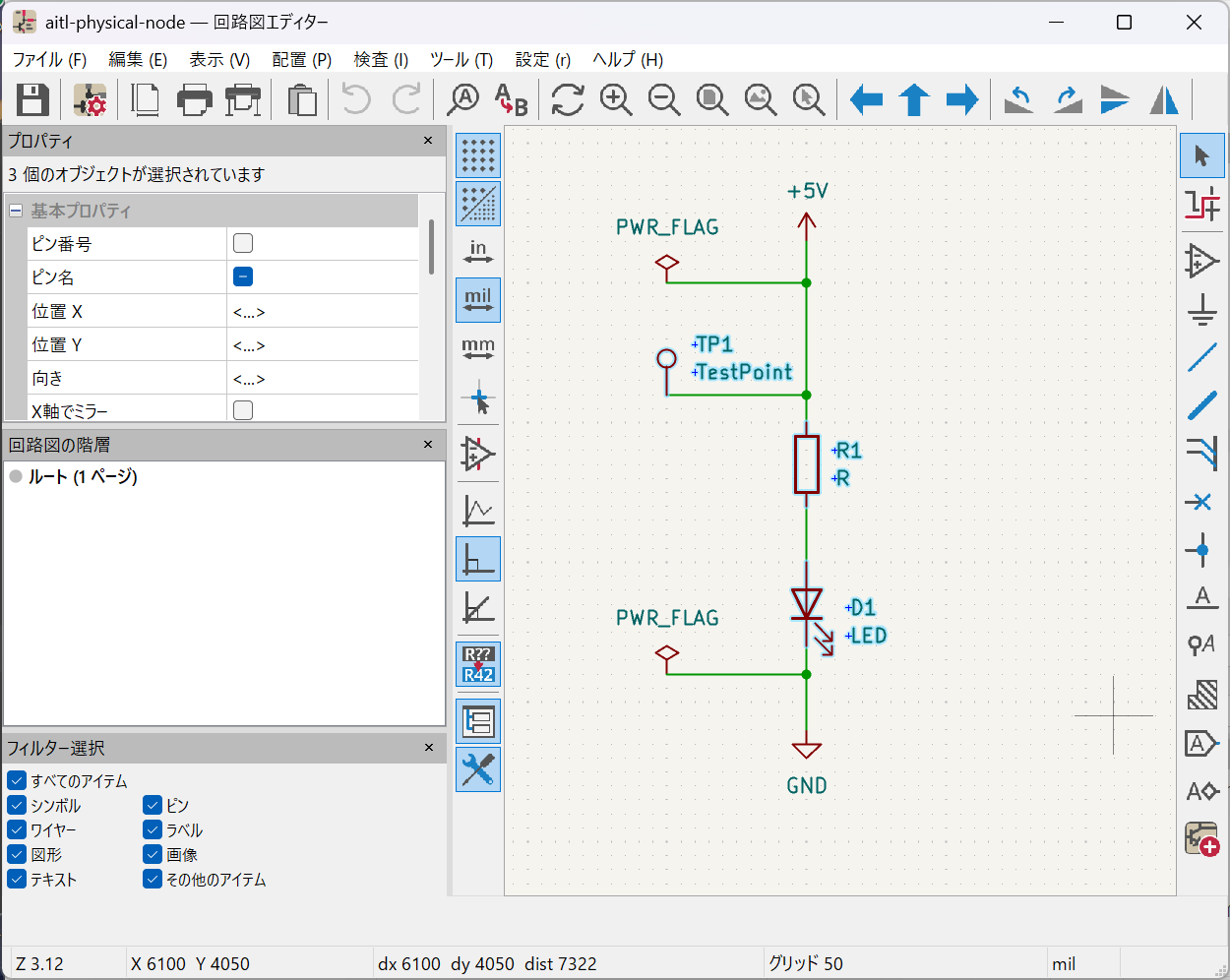
Logical signals are, for the first time, explicitly routed outside.
However:
- No state transitions are defined
- No feedback loop exists
- No time response is specified
It allows the illusion of control,
but control itself does not yet exist.
2️⃣ PCB Layout (v1): Copper Quietly Restricts Freedom
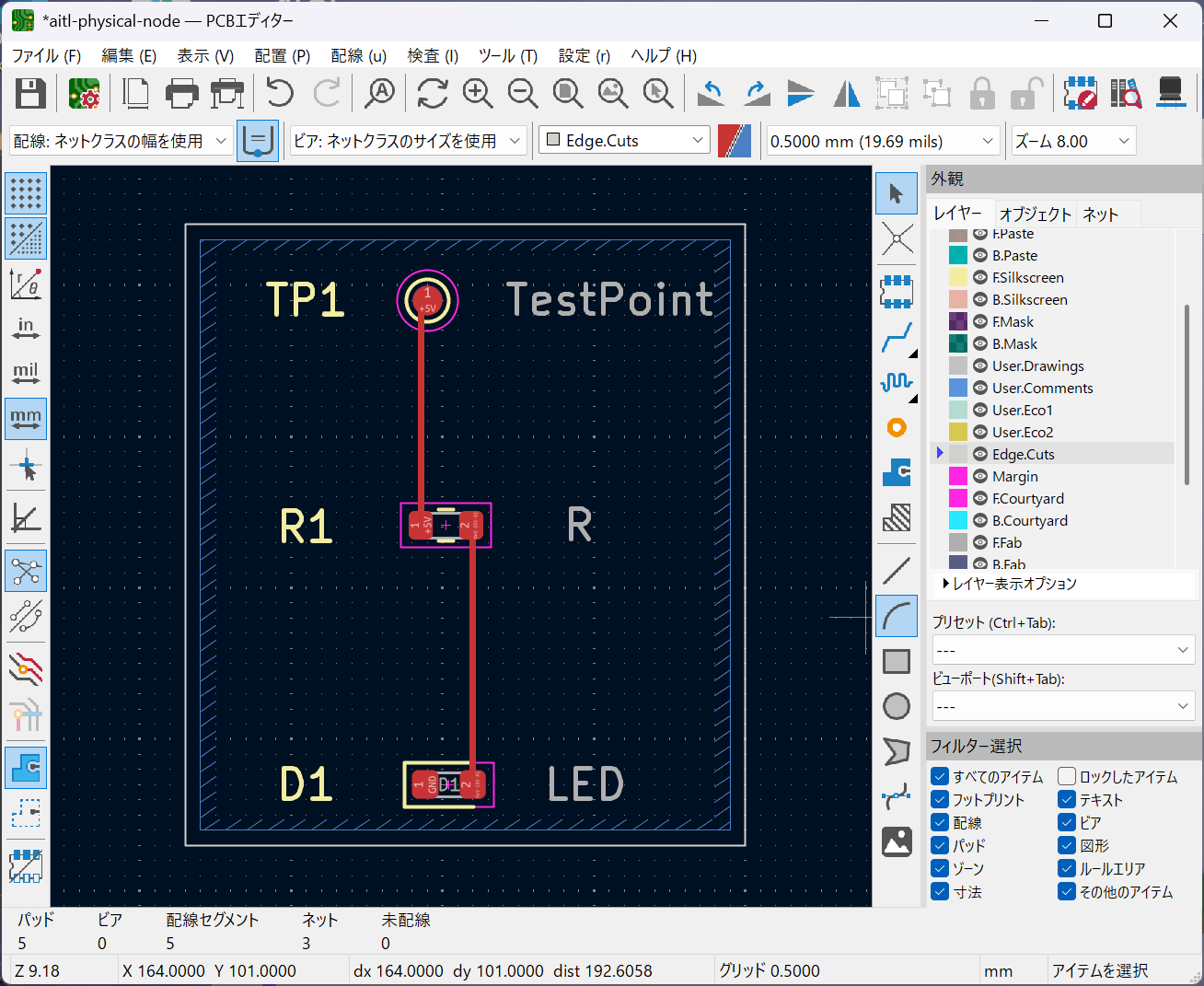
Even as logic increases,
current still flows only on this copper.
- Trace length
- Return paths
- Component placement
- Board outline
None of these can be bypassed by control logic.
The degrees of freedom of control are silently constrained by physics.
This layout exists to make that visible.
3️⃣ 3D View (v1): The Object Exists, Control Does Not
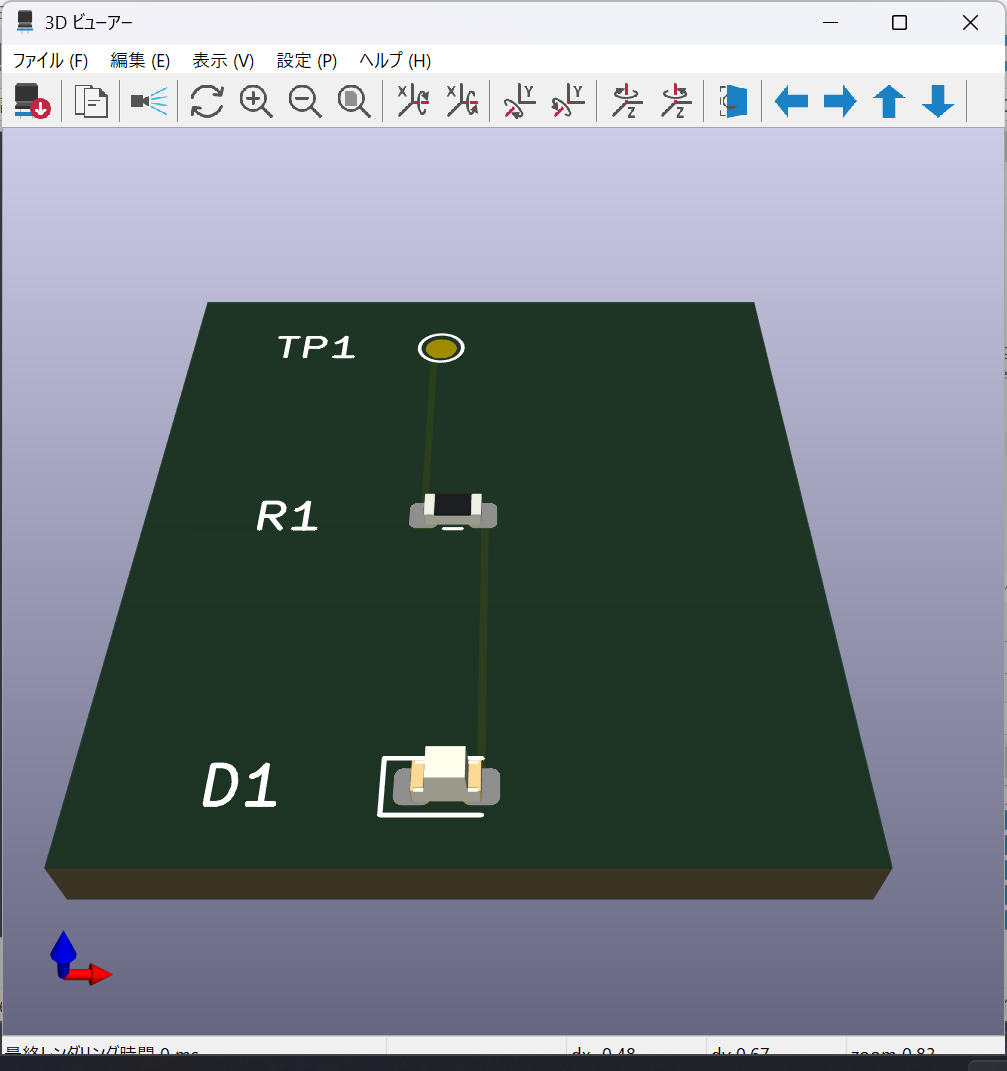
It has height.
It has touchable components.
It has measurable points.
And yet, this board
still does nothing.
Here, we deliberately stop the misconception that
“implemented” means “controllable.”
🧭 The True Nature of v1: A Boundary Definition Reference
aitl-physical-reference v1 is:
- Not an MCU evaluation board
- Not a control demo board
It is a reference that fixes the boundary between logic and physics.
- Test Points define the observation boundary
- Resistors define physical constraints
- The PCB outline defines the edge of the world
This is the board that draws the line
before control is allowed to step in.
🧩 Position Within AITL
In AITL (Architecture for Integrated Technology Logic),
the layers are explicitly separated:
- Physical layer
- Logical layer
- Adaptive layer
v1 belongs entirely to the lowest layer.
It is the reference point of the Physical layer.
Only after this layer is fixed
do higher-level control and reasoning gain meaning.
⏭️ What Comes Next
In v2, behavior will be introduced for the first time.
- But still not AI
- Still not optimization
What comes first is:
Control that humans can fully explain
🧾 Summary
Control was not added because
there was still physics left to fix.
aitl-physical-reference v1 is
a design that deliberately pauses
in order to move forward correctly.
Before control,
physics must exist as it truly is.
v1 is the reference that marks that boundary.
🔗 Links
-
GitHub Pages
https://samizo-aitl.github.io/aitl-physical-reference/ -
GitHub Repository
https://github.com/Samizo-AITL/aitl-physical-reference