【Semiconductor】🔬 22. What Does Failure Analysis (FA) Decide?
— A Technique for Determining Corrective Targets, Not Mere Observation
topics: [“Semiconductor”, “Failure Analysis”, “FA”, “OBIRCH”, “Quality”]
🧭 Introduction
Failure Analysis (FA) is not simply
“an activity to investigate why something broke.”
The objective of FA is explicit:
To determine whether an observed failure is caused by
process-related factors or design-related factors,
and to identify the appropriate corrective target
In this article, we explain:
- The role of FA in manufacturing
- Why OBIRCH is a mainstream analysis technique
- Why failure analysis must not be terminated prematurely
from the perspective of the final step in the mass-production quality loop.
🔬 Definition and Role of FA
FA takes as its input failure results detected in:
- ETEST
- Wafer testing (WAT)
- Reliability testing
and proceeds to physically identify the root cause of those failures.
The ultimate purpose of FA is:
To determine corrective actions that prevent recurrence
Corrective actions in this context include decisions on whether to return the issue to:
- Manufacturing process conditions
- Equipment or materials
- Design rules or device models
FA must clearly determine which domain requires correction.
🔦 Why OBIRCH Is Used
Leakage currents and micro-shorts cannot be identified
by observing layouts or cross-sectional structures alone.
OBIRCH (Optical Beam Induced Resistance Change) is a technique that:
- Maintains the device under bias
- Irradiates a localized region with an infrared laser
- Detects resistance changes and localized heating
This enables visualization of:
- Locations where current is actually flowing
- Coordinates at which failures are actively occurring
while the device is operating.
In FA, the critical requirement is:
To observe failures in the state in which they occur
In this regard, OBIRCH is an extremely effective technique.
🧪 Failure Analysis Is Performed Step by Step
FA does not rely on a single method.
In practice, a stepwise analysis flow is typically employed:
- Localization of the failure site using OBIRCH
- Identification of the defective layer through delayering
- Surface and structural observation using SEM
- Local cross-sectioning using FIB
- Elemental composition analysis using EDX
By accumulating information at each stage,
possible causes are systematically eliminated until a definitive conclusion is reached.
If analysis is stopped prematurely, it increases the risk of:
- Conclusions based on assumptions
- Incorrect corrective actions
- Recurrence of the same failure
🖼 Overview of Failure Analysis (FA)
— Step-by-Step Analysis Flow Centered on OBIRCH —
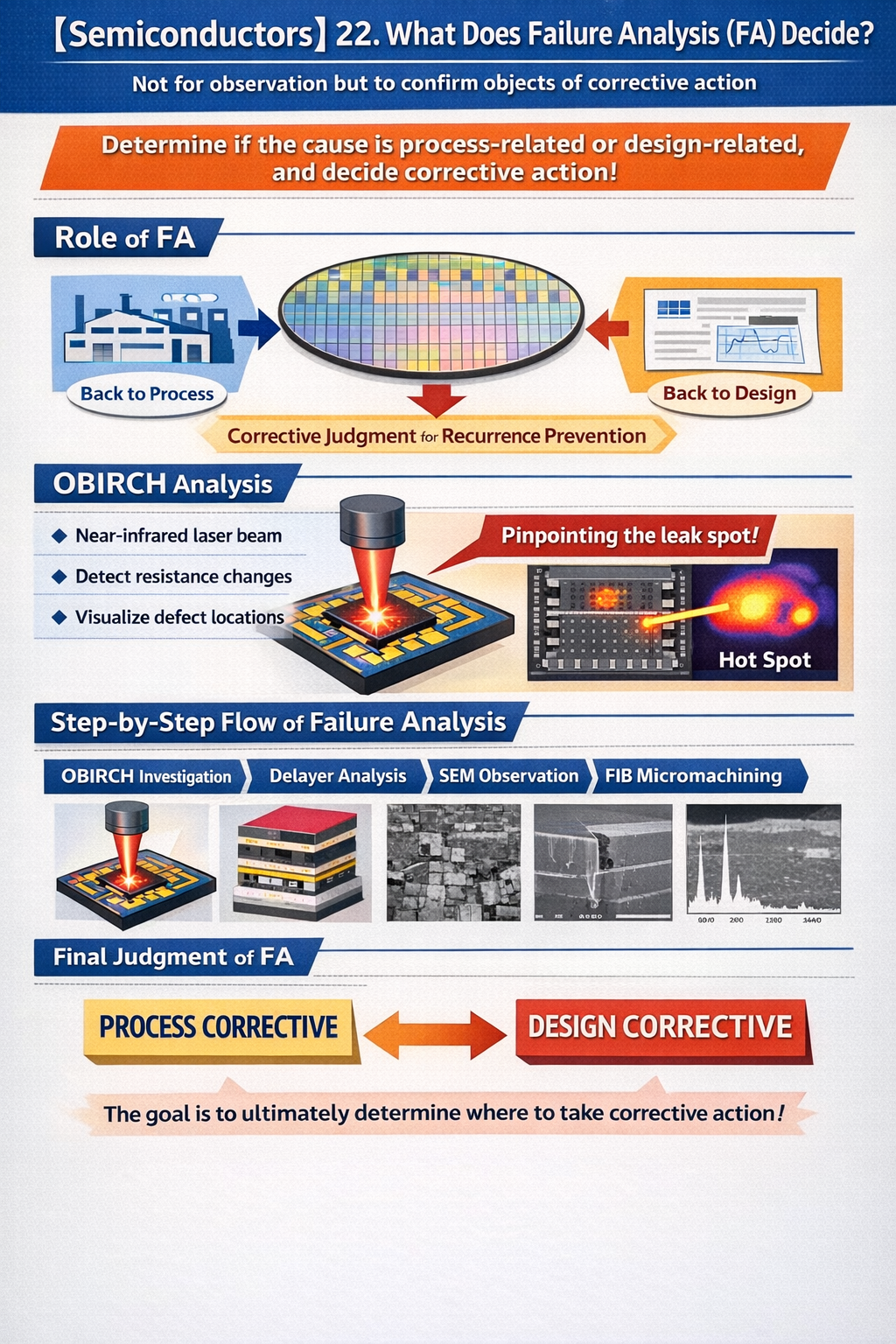
Figure: The role of Failure Analysis (FA) and the step-by-step analysis flow starting from OBIRCH.
The ultimate goal of FA is to determine whether the corrective action should be applied to the manufacturing process or to the design.
🧠 What Is the Output of FA?
The outputs of FA are not:
- Microscopy images
- Analysis reports
in themselves.
The true output of FA is:
A decision on whether corrective action is required
in the manufacturing process or in the design
When this decision is fed back into the production line,
the quality loop is closed and recurrence prevention is achieved.
📝 Summary
- FA physically identifies the root cause of observed failures
- Its objective is not observation, but determination of corrective targets
- OBIRCH is effective for visualizing failures under operating conditions
- FA represents the final decision point in the manufacturing quality loop
🌐 Official Link (Edusemi-v4x)
- 📂 Chapter 6 Test & Package (Official)
https://samizo-aitl.github.io/Edusemi-v4x/chapter6_test_and_package/