【Semiconductor】19. What Happened to PSRAM, and Why Did It End?
— The Reality of Pause × Disturb
topics: [“Semiconductor”, “PSRAM”, “DRAM”, “Reliability”, “Yield”]
🧭 Introduction
In the previous article, we organized how PSRAM was built upon the following
structure and assumptions:
- Using DRAM cells
- Employing internal refresh control
- Presenting itself as SRAM-like to the outside
In this article, we record
what actually happened under those assumptions,
and what decisions were ultimately made.
⚠️ Failures That Surfaced in PSRAM
The failures that became problematic in PSRAM
can be broadly classified into two types:
- Pause Refresh Fail
- Disturb Refresh Fail
Both were already known phenomena in DRAM,
but in PSRAM the decisive difference was that
they appeared simultaneously depending on usage conditions.
⏸ Pause Refresh Fail (PSRAM)
In PSRAM, the following conditions tended to overlap:
- Long standby periods
- Intermittent internal refresh
- Operation in high-temperature environments
As a result,
Leakage that did not surface in DRAM
appeared directly as retention failure
This was not:
- A new physical phenomenon
- A new defect
It was fundamentally the same as
the Pause Refresh anomaly already observed in 0.25 µm DRAM.
⚡ Disturb Refresh Fail (PSRAM)
The other problem was Disturb.
In PSRAM, the following usage patterns occurred routinely:
- Access concentrated on specific addresses
- Other regions remaining idle for long periods
As a consequence, the following coexisted on the same chip:
- Frequently toggled word lines
- Cells left untouched for extended durations
🧬 Cross-Sectional Structure Where Disturb Occurs (Reference)
Here, we present
the physical device cross-section
necessary to understand Disturb in PSRAM.
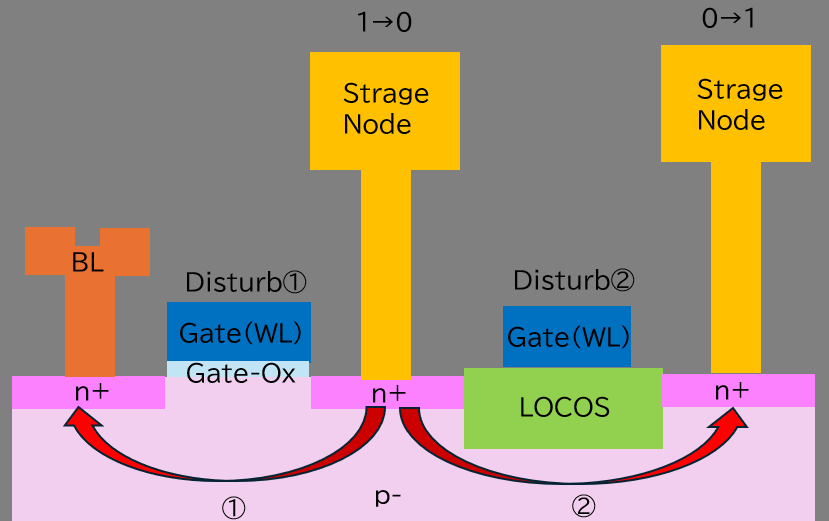
Figure 1: Conceptual cross-section of leakage and electric-field concentration during Disturb events in PSRAM (using DRAM cells)
What this figure illustrates are
well-known physical effects, such as:
- Electric-field concentration during word-line switching
- Increased Ioff due to short-channel effects in cell MOS transistors
- Amplified leakage at diffusion edges and isolation boundaries of adjacent cells
Disturb operates not as:
a one-time destructive event,
but as:
a phenomenon that accumulates minute degradation over time.
🔗 Coupling of Pause × Disturb
The critical point is that
Pause and Disturb were not fatal when acting alone.
- Pause by itself
- Disturb by itself
were both contained within guaranteed conditions.
The problem arose when:
the two became coupled along the time axis
In that case:
- Disturb gradually eroded cell state
- Pause provided no opportunity for recovery
- High temperature exponentially accelerated leakage
Through this chain,
failures increased at a boundary rather than gradually.
🌡 Temperature as a Boundary Condition
The failure behavior of PSRAM
changed character abruptly when a temperature boundary was crossed.
- Up to ~85 °C: failures were almost nonexistent
- At 90 °C (guaranteed point): conditionally acceptable
- Above 95 °C: failures increased sharply
Failures did not:
- Increase slowly
- Degrade progressively
Instead, they:
appeared the moment a certain condition was exceeded
This was a boundary phenomenon.
🛠 What Yield Recovery Could and Could Not Achieve
Mass production could not be halted.
Therefore,
short-term feasible countermeasures were implemented.
Implemented Measures
- Reduction of process-induced damage
- Suppression of junction leakage
- Optimization of back-bias conditions
- Redefinition of test conditions
As a result:
- Initial yield: ~30%
- Post-recovery yield: on the order of 70–80%
🧱 Limits That Still Remained
However, the following did not change:
- Extremely thin high-temperature margin
- Persistent dependence on usage patterns
- Further degradation with continued scaling
These were not due to:
- Insufficient improvement
- Implementation mistakes
They were structural limitations.
🧭 The Decision That Was Made
The final decision was unambiguous.
Even if a technology can be made to work,
it should not be continued if it cannot scale long-term
- PSRAM became manufacturable
- But it could not be carried into future generations
- Return on investment could not be justified
As a result:
Withdrawal from the PSRAM roadmap
was chosen.
🧾 Summary (Failures and Decision)
PSRAM was:
- Not a failed technology
- But not a sustainable one either
The limits were created by
the coupling of well-known physics—
Pause × Disturb × temperature—
through the way the memory was used.
This was not:
- A design failure
- An implementation error
It was a record of:
assumptions exceeding the range that could be tolerated
🔗 Primary Sources (References)
-
Legacy Technology Archive
https://samizo-aitl.github.io/Edusemi-Plus/archive/legacy/ -
PSRAM (2001) Cases
https://samizo-aitl.github.io/Edusemi-Plus/archive/legacy/psram_2001/ -
Pause / Disturb in PSRAM
https://samizo-aitl.github.io/Edusemi-Plus/archive/legacy/psram_2001/pause_disturb_psram/ -
Yield Recovery
https://samizo-aitl.github.io/Edusemi-Plus/archive/legacy/psram_2001/yield_recovery/
✅ Series Complete
- 0 Introduction
- 1 DRAM Part 1 (Phenomenology)
- 2 DRAM Part 2 (Physics)
- 3 PSRAM Part 1 (Structure)
- 4 PSRAM Part 2 (Failures and Decision)
All five articles are now complete.