【Semiconductor】 ⏱️ 08-08. What Is NBTI? — How MOSFETs Degrade Over Time”
topics: [“Semiconductor”, “NBTI”, “Reliability”, “MOSFET”, “BSIM4”]
⏱️ Introduction
In the previous articles, we have examined initial MOSFET characteristics through:
- 🧪 TCAD for physical understanding
- 📐 BSIM4 for compact modeling
- 🔌 SPICE for electrical characterization
However, in real silicon devices, there is an unavoidable reality:
A device that works well today may not behave the same way five years later.
One of the most representative causes of this behavior is
👉 NBTI (Negative Bias Temperature Instability).
NBTI is a fundamental reliability issue that explains how
MOSFETs gradually degrade over time.
🔥 What Is NBTI?
NBTI mainly affects pMOSFETs when the following conditions coexist:
- Negative gate bias
- Elevated temperature
- Long operating time
It is therefore classified as a
time-dependent reliability degradation mechanism.
Its most distinctive feature is:
The threshold voltage $V_t$ shifts as a function of time.
🧠 What Is Happening Physically?
Under NBTI stress conditions, near the gate-oxide / silicon interface:
- Interface states are generated
- Trap states become activated and permanently charged
As a result:
- Even with the same applied $V_g$
- The same channel charge density cannot be formed
👉 The MOSFET becomes harder to turn on
This manifests as reduced on-current and increased delay.
📉 Impact on V–I Characteristics
NBTI effects appear directly in DC characteristics.
Typical observations include:
- A rightward shift of the $V_g$–$I_d$ curve
- Degradation of subthreshold behavior
- Reduced $I_d$ at the same $V_g$
All of these are consequences of:
Threshold voltage shift ($\Delta V_{th}$)
📐 How BSIM4 Treats NBTI
In BSIM4, NBTI is represented as:
- Degradation modeled through parameter variation
- Time-dependent $V_t$ shift
- Comparison of characteristics before and after degradation
A critical limitation must be noted:
BSIM4 alone does not directly solve time evolution
For this reason, SemiDevKit adopts a hybrid approach:
- 🧪 SPICE: Accurate measurement at $t = 0$
- 🧮 Python: Time-dependent degradation modeling for $t > 0$
🧰 NBTI Analysis with SemiDevKit
The following module is used:
- BSIM4 Analyzer Reliability
https://samizo-aitl.github.io/SemiDevKit/bsim/bsim4_analyzer_reliability/
This framework provides fully automated:
- Initial VG–ID extraction
- Threshold voltage extraction using gmmax and constant-current methods
- Application of time-dependent degradation models
- Reconstruction of degraded device characteristics
🔬 NBTI Analysis Flow
t = 0
 ├─ VG–ID sweep
 │     ├→ Vtg0 (gmmax method)
 │     └→ Vtc0 (constant-current method)
 ├─ DC extraction
 │     └→ Idlin0 / Idsat0

t > 0
 ├─ Apply ΔVth(t) model
 ├─ Apply ΔId(t) model
 ├─ Reconstruct Vtg1 / Vtc1 / Idlin1 / Idsat1

→ Export CSV results
→ Generate degradation plots
→ Overlay VG–ID curves
🚀 Execution Example
cd bsim/bsim4_analyzer_reliability/run
python run_nbti_pmos.py
📊 Example Results
■ PMOS NBTI: Vg–Id Degradation (Linear Scale)
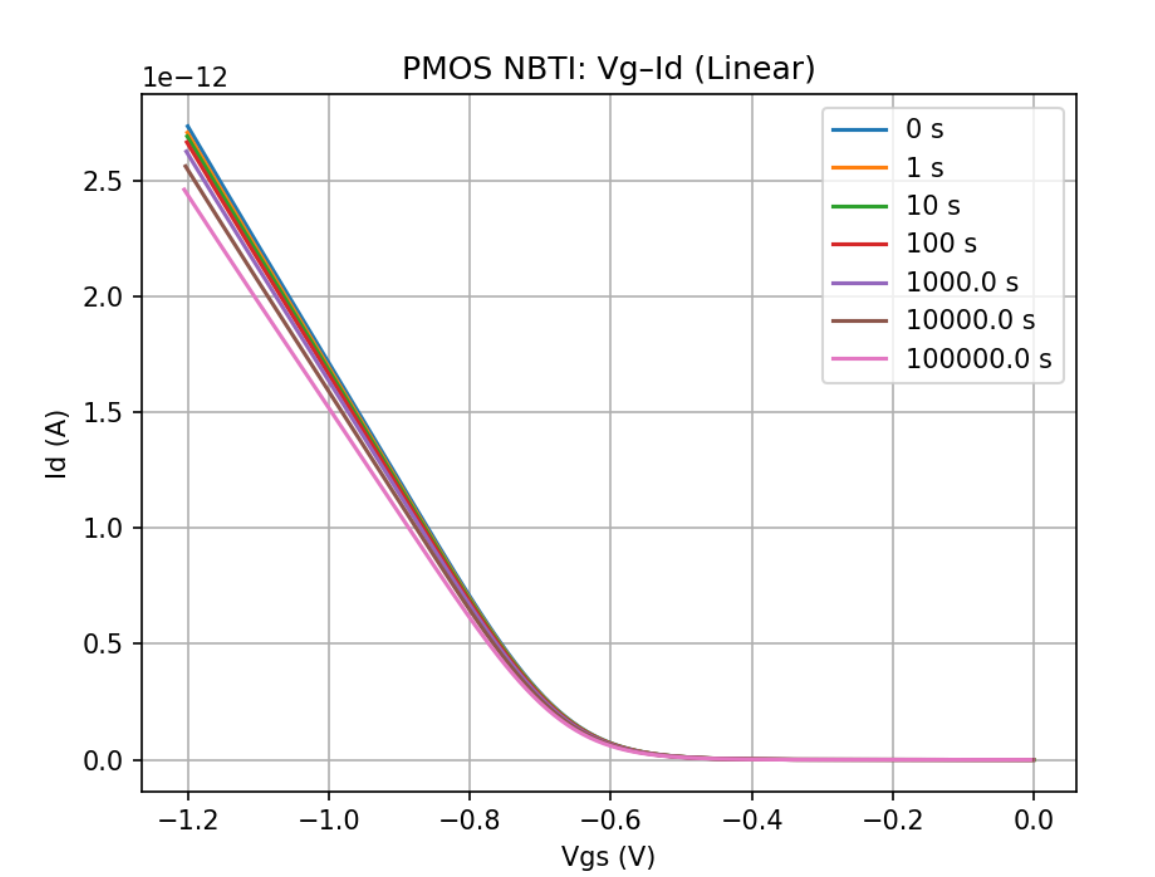
👉 Clear rightward shift of the Vg–Id curve
👉 Reduced drain current at the same gate voltage
■ PMOS NBTI: ΔVtg vs. Stress Time
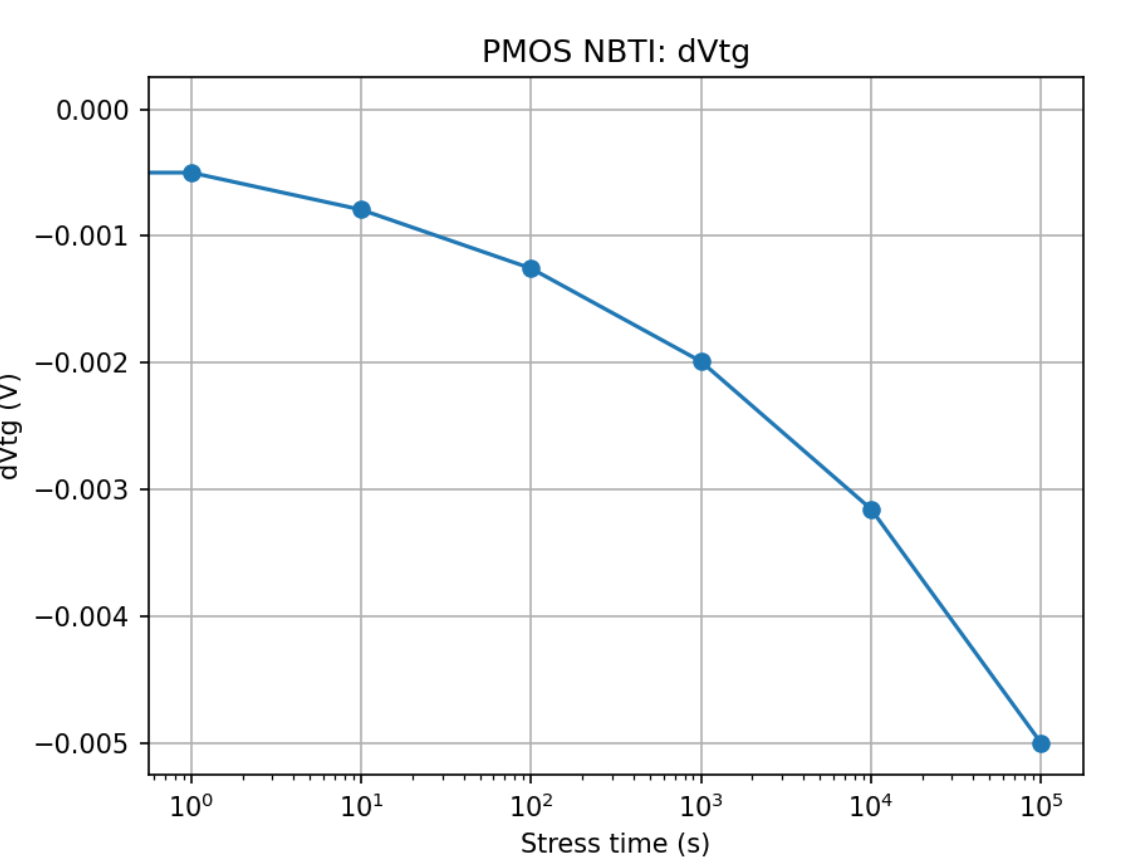
👉 Degradation follows a power-law time dependence
👉 Early-stage degradation is dominant
⚠️ Why NBTI Matters
NBTI leads to:
- Reduced operating frequency
- Loss of timing margin
- Long-term reliability failure
It is especially critical for:
- Low-voltage operation
- SRAM and low-$V_{dd}$ logic
- Long-lifetime products (automotive, industrial)
👉 NBTI is a hard constraint, not an optional consideration.
🔗 TCAD / BSIM / SPICE Relationship
NBTI fits naturally into the same conceptual chain:
- TCAD: Physical processes at the interface
- BSIM4: Parameterized degradation models
- SPICE: Circuit-level impact assessment
👉 Reliability is also a “physics → model → circuit” problem.
📝 Summary
- ⏱️ NBTI is a time-dependent reliability degradation mechanism
- 🟦 It primarily affects pMOSFETs
- 📉 It appears as a threshold voltage shift
- 🧪 BSIM4 + SPICE + Python enable clear visualization
MOSFETs are no longer evaluated by:
“Does it work?”
but by:
“How long does it keep working?”
Next Article 👉
09: What Is HCI? — Why High Electric Fields Destroy MOSFETs