【Semiconductor】📏 08-07. Visualizing MOSFET L/W Scaling and Short-Channel Effects with SPICE
topics: [“Semiconductor”, “MOSFET”, “Scaling”, “Short-Channel Effects”, “BSIM4”]
🚀 Introduction
MOSFETs are often described as devices where
“smaller means faster.”
However, in real silicon, shrinking a device also reveals another face:
- ⚠️ Reduced controllability
- ⚠️ Increased leakage current
- ⚠️ Enhanced parameter variability
In this article, using BSIM4 models and SPICE simulations, we perform
L/W dimensional scaling analysis to understand:
- Why device characteristics change when dimensions shrink
- Where textbook intuition breaks down in real devices
All observations are based on actual simulation results.
📐 What Is Dimensional Scaling?
MOSFET dimensional scaling examines the impact of changing:
- Channel length: $L$
- Device width: $W$
For an ideal long-channel MOSFET, one might expect:
- $I_d \propto W$
- $I_d \propto 1/L$
However, real devices deviate significantly from this ideal behavior.
The root cause of this deviation is known as
👉 Short-Channel Effects (SCE).
🧰 Analysis Environment (SemiDevKit)
This article uses the following DIM analysis module:
- BSIM4_ANALYZER_DIM
https://samizo-aitl.github.io/SemiDevKit/bsim/bsim4_analyzer_dim/
Key Features
- Python + ngspice
- BSIM4 (130 nm educational model)
- Fully automated flow:
- L/W-dependent model generation
- Netlist creation
- SPICE execution
- CSV / PNG output
👉 Enables hands-free comparison of dimensional dependence.
🔬 Channel Length ($L$) Scaling
How to Run
cd bsim/bsim4_analyzer_dim/run
python run_vg_dim.py
python run_vd_dim.py
This analysis varies the channel length $L$ step by step and compares:
- Vg–Id (transfer characteristics)
- Vd–Id (output characteristics)
⚠️ What Happens When $L$ Becomes Shorter?
From the simulation results, we observe:
- 📉 Threshold voltage roll-off
- 📉 Reduced output resistance
- ⚡ DIBL (Drain-Induced Barrier Lowering)
- ⚠️ Degraded current saturation
These phenomena collectively define
👉 Short-Channel Effects (SCE).
■ Vg–Id (L Sweep, NMOS)
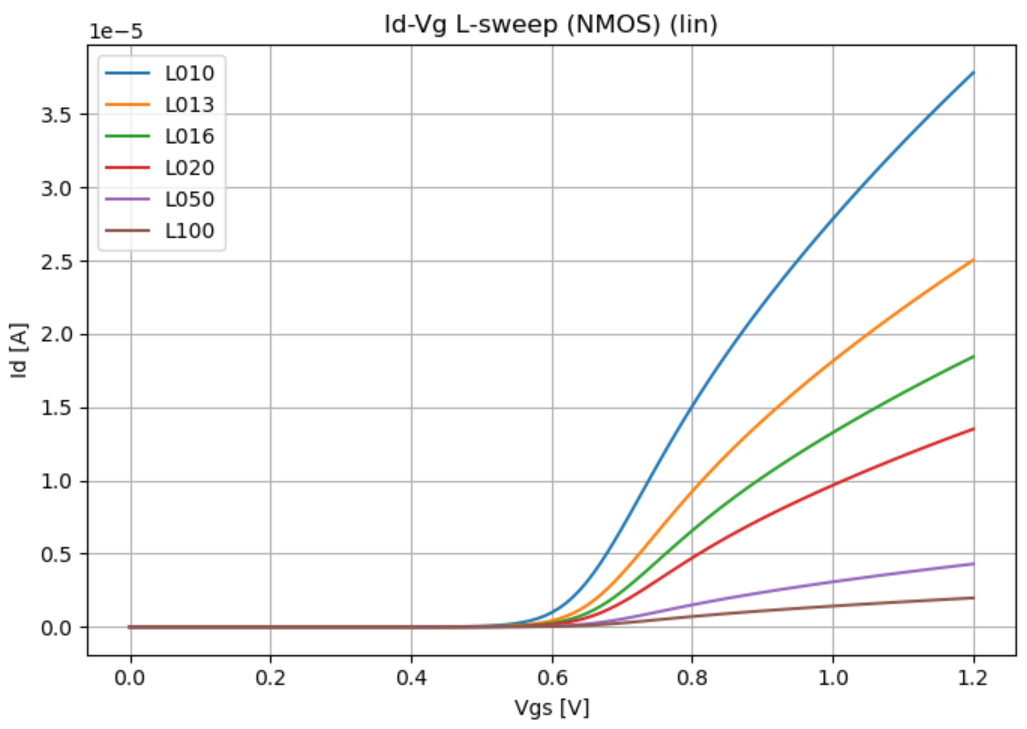
👉 Shorter $L$ lowers $V_{th}$ and increases leakage
👉 $g_m$ enhancement and loss of gate control occur simultaneously
■ Vd–Id (L Sweep, NMOS)
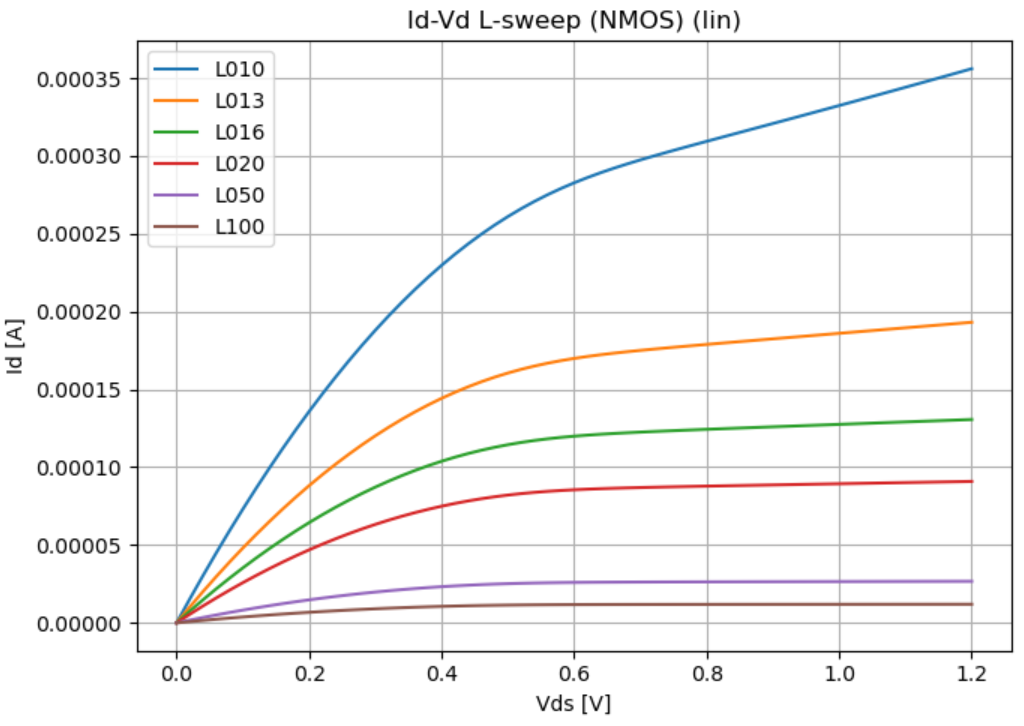
👉 Weaker saturation and stronger $V_d$ dependence
👉 A classic signature of DIBL
📏 Device Width ($W$) Scaling
How to Run
cd bsim/bsim4_analyzer_dim/run
python run_vg_dim.py
python run_vd_dim.py
(Only the fixed-width condition is changed.)
🤔 Intuition vs. Reality in $W$ Scaling
Intuitively, one might expect:
- Increasing $W$ → proportional increase in current
In practice, however, the following effects become significant:
- Parasitic resistance ($R_{dsw}$)
- Parasitic capacitance ($C_{gg}$)
- Narrow-width effects
👉 Increasing width does not solve everything
👉 This is a critical consideration in standard-cell design
🧠 The Role of BSIM4
BSIM4 explicitly includes:
- Threshold voltage roll-off
- DIBL
- Mobility degradation
- Narrow-width effects
as dimension-dependent parameters.
As a result, SPICE simulations alone can reveal:
“What breaks when the device is scaled.”
This makes BSIM4 an effective bridge between device physics and circuit design.
🔗 Relationship with TCAD
In TCAD simulations, short-channel scaling shows:
- Distorted electrostatic potential
- Drain electric field penetrating into the channel
BSIM4 DIM analysis:
- Compresses these spatial effects
- Into observable I–V characteristics
👉 BSIM4 acts as a bridge between TCAD and circuit-level design.
💡 The True Value of DIM Analysis
DIM analysis is particularly valuable for:
- SRAM β-ratio design
- Standard-cell drive-strength tuning
- Performance vs. leakage trade-off studies
👉 It reveals how far scaling can be pushed before functionality degrades.
📝 Summary
- 📏 L/W scaling strongly alters MOSFET characteristics
- ⚠️ Shorter $L$ introduces short-channel effects
- 📐 Increasing $W$ is not a simple linear solution
- 🧠 BSIM4 + SPICE enable realistic device behavior analysis
To understand MOSFETs as real devices rather than equations,
DIM analysis is an indispensable tool.
Next Article 👉
08: What Is NBTI? — How MOSFETs Degrade Over Time