【Semiconductor】 📈 08-05. Reading MOSFET DC Characteristics with BSIM4 — Vg–Id / Vd–Id Analysis
topics: [“Semiconductor”, “BSIM4”, “SPICE”, “DC Analysis”, “MOSFET”]
🧭 Introduction
In the previous article, we covered BSIM4 model generation using Paramus.
Once a model card is created, there is one essential next step:
Verify what kind of V–I characteristics the model actually exhibits.
In this article, we use DC analysis with a BSIM4 MOSFET model to visualize:
- Gate voltage sweep: $V_g$ – $I_d$ characteristics
- Drain voltage sweep: $V_d$ – $I_d$ characteristics
Through these plots, we organize the basic MOSFET operation and the
physical meaning of model parameters.
🔍 What Is DC Analysis?
DC analysis evaluates the steady-state voltage–current (V–I) relationship,
ignoring time-dependent effects.
For MOSFETs, the two most important DC characteristics are:
- $V_g$ – $I_d$ (transfer characteristics)
- $V_d$ – $I_d$ (output characteristics)
These characteristics are the starting point for:
- Device understanding
- Model validation
- Circuit design and evaluation
They are the most fundamental and essential characteristics.
🧰 Analysis Environment (SemiDevKit)
In this article, we use the BSIM4 DC Analyzer included in SemiDevKit.
🔗 Tool Page
BSIM4_ANALYZER_DC | SemiDevKit
Features
- Automated DC analysis using BSIM4 × ngspice × Python
- NMOS / PMOS (130 nm) support
- Automatic plotting of $V_g$–$I_d$ and $V_d$–$I_d$
- Automatic extraction of $V_t$, $g_{m,\max}$, $I_{d,\mathrm{lin}}$, $I_{d,\mathrm{sat}}$
- Designed for education, with a view toward future commercial-grade analysis tools
Prerequisites
- BSIM4 model card (generated by Paramus)
- ngspice
- Python 3.10 or later
📉 Vg–Id Analysis (Gate Voltage Sweep)
How to Run
cd bsim/bsim4_analyzer_dc/run
python run_vgid.py
This script automatically performs:
- SPICE netlist generation
- ngspice execution
- Numerical data extraction
- Linear and logarithmic plotting
NMOS: $V_g$ – $I_d$ Characteristics (Example)
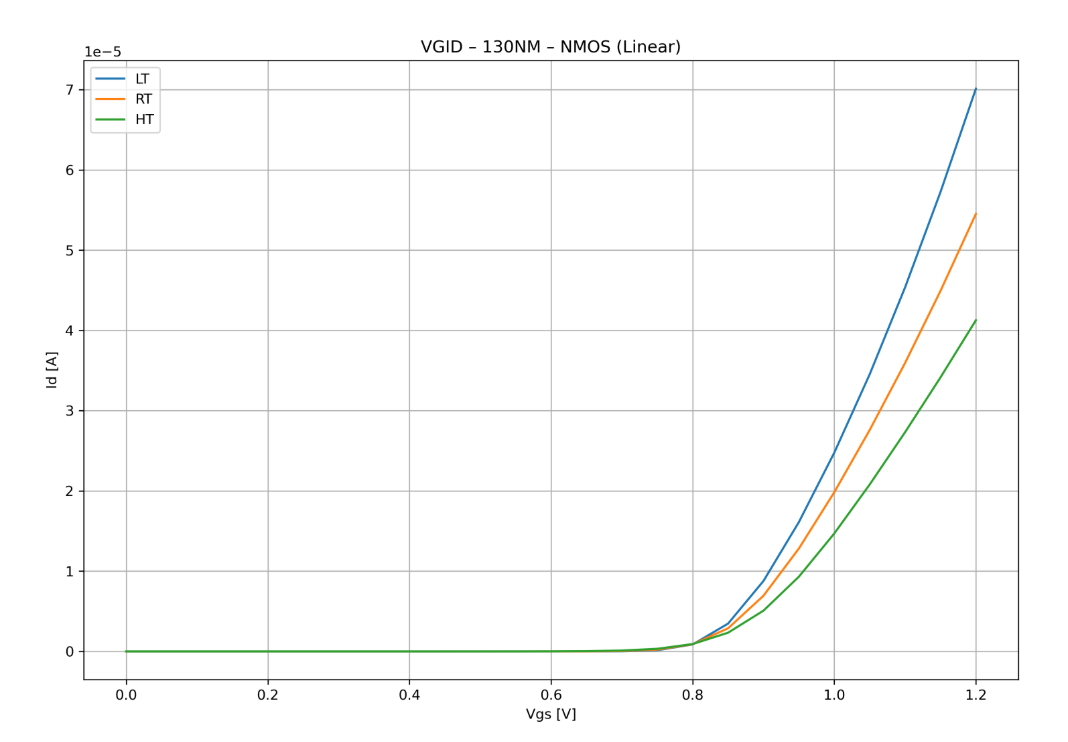
- Horizontal axis: gate voltage $V_g$
- Vertical axis: drain current $I_d$
From this plot, you can extract:
- Threshold voltage $V_t$
- Subthreshold region behavior
- On-current level
- Gate control capability
($g_m = \partial I_d / \partial V_g$)
What you observed in TCAD as “channel formation”
appears here directly as V–I characteristics.
PMOS: $V_g$ – $I_d$ Characteristics
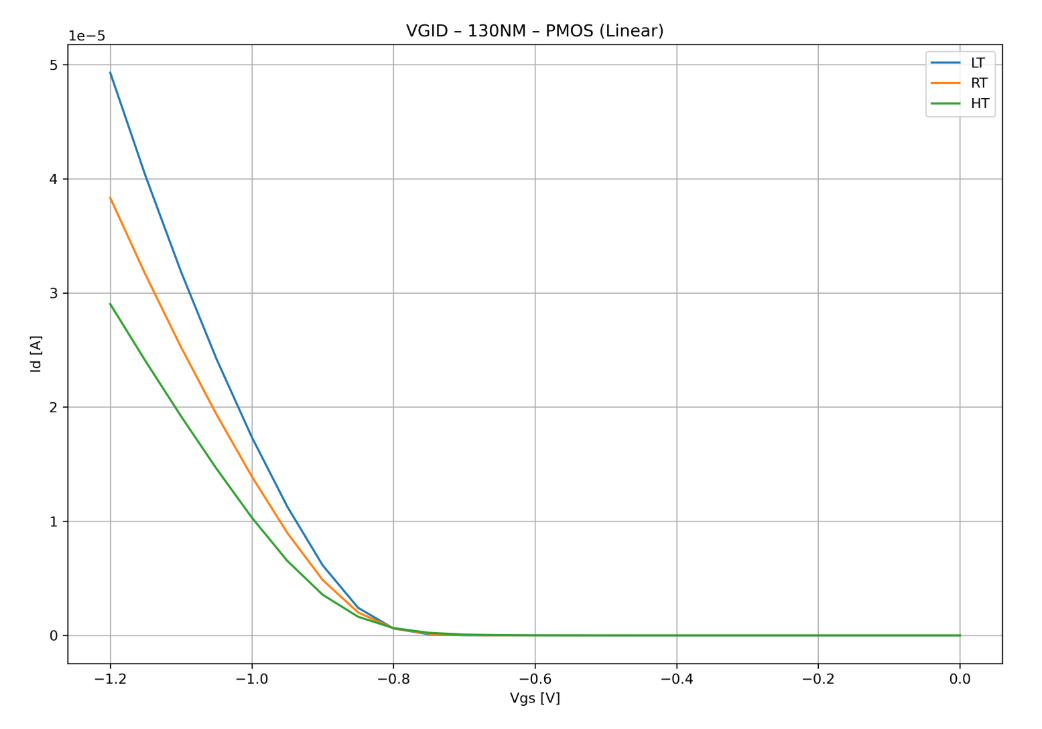
For PMOS, characteristics are plotted using SPICE polarity conventions.
Temperature-dependent changes in $|V_t|$ and mobility can also be observed.
📊 Vd–Id Analysis (Drain Voltage Sweep)
How to Run
cd bsim/bsim4_analyzer_dc/run
python run_vdid.py
NMOS: $V_d$ – $I_d$ Characteristics (Example)
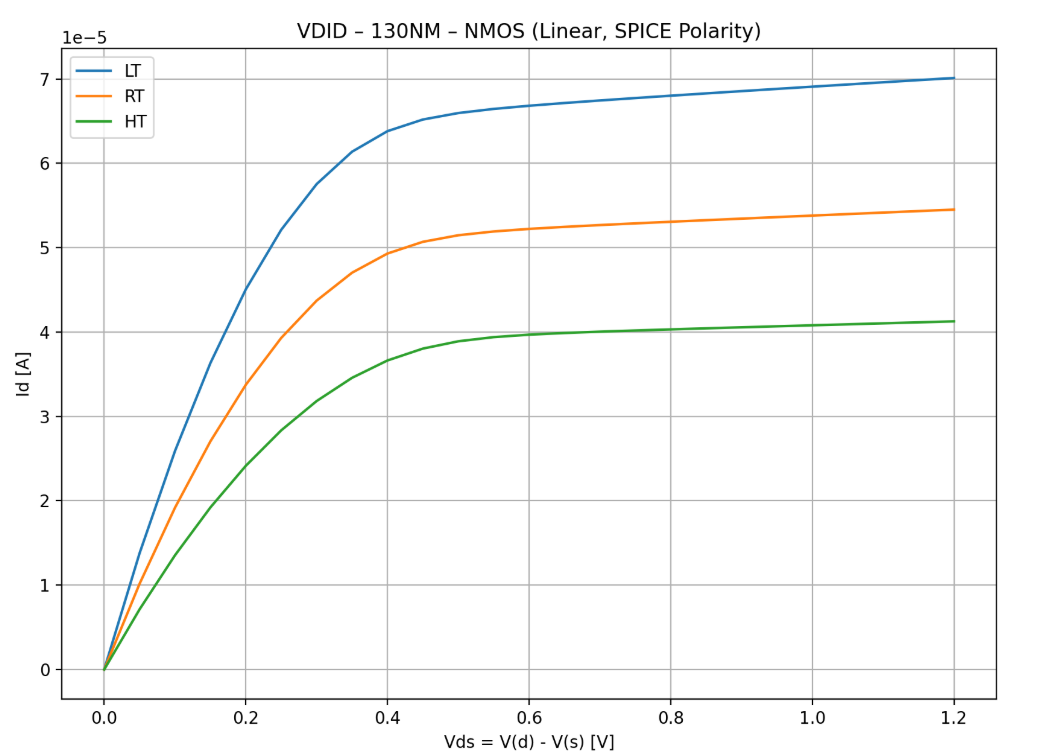
- Horizontal axis: drain voltage $V_d$
- Vertical axis: drain current $I_d$
From this plot, you can clearly identify:
- Linear region (low $V_d$)
- Saturation region
- Channel-length modulation (output resistance $r_o$)
These are the operating regions of a MOSFET,
clearly revealed by DC analysis.
PMOS: $V_d$ – $I_d$ Characteristics
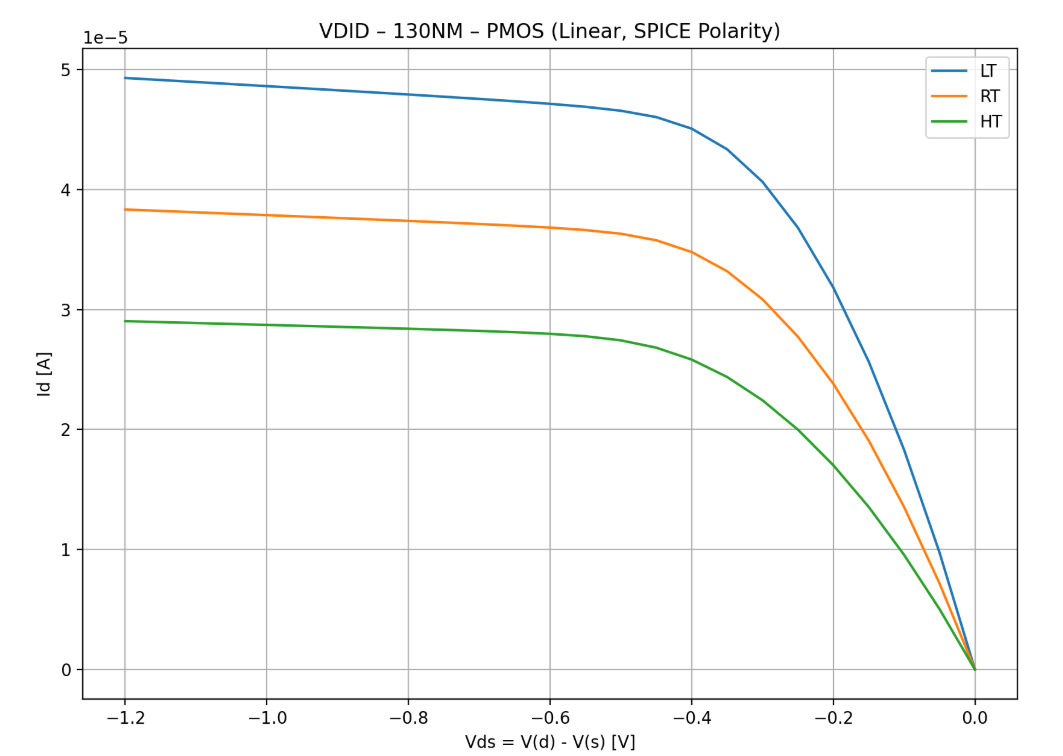
This analysis is also useful for:
- Extracting $I_{d,\mathrm{lin}}$ and $I_{d,\mathrm{sat}}$
- Comparing short-channel effects
🧠 Linking DC Characteristics to Physical Models
The V–I characteristics obtained from DC analysis are not black boxes.
| DC Characteristic | Corresponding Physical Factors |
|---|---|
| $V_t$ | Doping concentration, oxide thickness |
| On-current | Mobility, channel length |
| Saturation | Velocity saturation, short-channel effects |
All of these are connected through the consistent flow:
TCAD → BSIM4 → SPICE
🧪 Why DC Analysis Is So Important
DC analysis is more than just plotting characteristics.
It serves as a sanity check to confirm that:
- The model is not broken
- Parameters are physically reasonable
- There are no abnormal voltage or temperature dependencies
AC analysis, CV analysis, and reliability analysis
all assume that DC characteristics are correct.
📝 Summary
- DC analysis is fundamental to MOSFET understanding
- $V_g$ – $I_d$ and $V_d$ – $I_d$ must always be checked
- The meaning of BSIM4 appears directly in V–I characteristics
- SemiDevKit enables automated and reproducible analysis
▶ Next Article
👉 06: BSIM4 AC / CV Analysis — Parasitic Capacitance and Frequency Response
Understanding BSIM4 starts with DC analysis.
The ability to read models is the ability to connect circuits and physics.