【Semiconductor】 🧠 08-02. Understanding the Essence of MOSFETs with TCAD — Poisson Equation and Drift–Diffusion
topics: [“Semiconductor”, “TCAD”, “MOSFET”, “Poisson Equation”, “Drift-Diffusion”]
🧭 Introduction — Where Do V–I Characteristics Come From?
The V–I characteristics of a MOSFET are not something that suddenly appear
inside a circuit simulator.
Their true origin lies in the physical phenomena occurring inside the device:
- Electrostatics (potential distribution)
- Carrier transport
In this article, from a TCAD (Technology Computer-Aided Design) perspective, we focus on:
- 🧮 the Poisson equation (which determines potential)
- 🚗 the Drift–Diffusion equations (which determine current)
to explain
👉 why MOSFET $V$–$I$ characteristics take the shape they do.
🔍 What Is TCAD?
TCAD is a simulation methodology that directly solves physical phenomena
inside semiconductor devices using numerical methods.
What you provide includes:
- Device structure
- Doping profiles
- Material parameters
- Bias conditions
And as a result, you can simultaneously and continuously observe:
- Electrostatic potential
- Electric field
- Carrier density
- Current density
📌 If circuit simulation is a world of “observing results,”
TCAD is the world of observing the moment those results are born.
🧮 Poisson Equation — The Origin of Everything
The Poisson equation is the foundation of semiconductor physics, linking:
Charge distribution → Potential distribution
In MOS structures:
- Gate voltage
- Oxide thickness $t_{ox}$
- Substrate doping $N_A$
control surface potential, which in turn governs channel formation.
In short:
Whether a channel forms or not is determined first by electrostatics.
🧱 What Happens in a MOS Structure (Role of Poisson)
As the gate voltage increases, the following sequence occurs in a MOS structure:
- Gate voltage is applied
- Surface potential changes through the oxide
- Carriers accumulate at the surface
- A channel is formed
All of this is governed by the Poisson equation.
👉 “Potential creates the channel.”
🚗 Drift–Diffusion Equations — What Determines Current
A channel alone does not produce current.
Current is determined by the Drift–Diffusion equations:
- Drift: carrier motion driven by electric fields
- Diffusion: carrier motion driven by concentration gradients
These equations naturally explain:
- Why $I_d$ increases when $V_d$ increases
- Why a linear region appears at low voltages
👉 “Transport equations create $I_d$.”
📈 V–I Characteristics Are a Stack of Physics
With TCAD, the following quantities are observed simultaneously:
- Potential distribution
- Carrier density distribution
- Current density distribution
As a direct consequence of these physical quantities stacking together:
- $V_g$–$I_d$ characteristics
- $V_d$–$I_d$ characteristics
emerge naturally.
🧪 SemiDevKit: An Educational 1D TCAD Playground
SemiDevKit provides a lightweight 1D TCAD environment
specifically designed for educational use.
- Poisson + Drift–Diffusion
- Implemented in Python
- One-to-one correspondence between equations, code, and plots
🔗 TCAD Top Page
https://samizo-aitl.github.io/SemiDevKit/tcad/
📊 Example ①: MOSCAP C–V Characteristics (Result of Poisson)
How does the C–V characteristic of a MOS capacitor change
when oxide thickness $t_{ox}$ is varied?
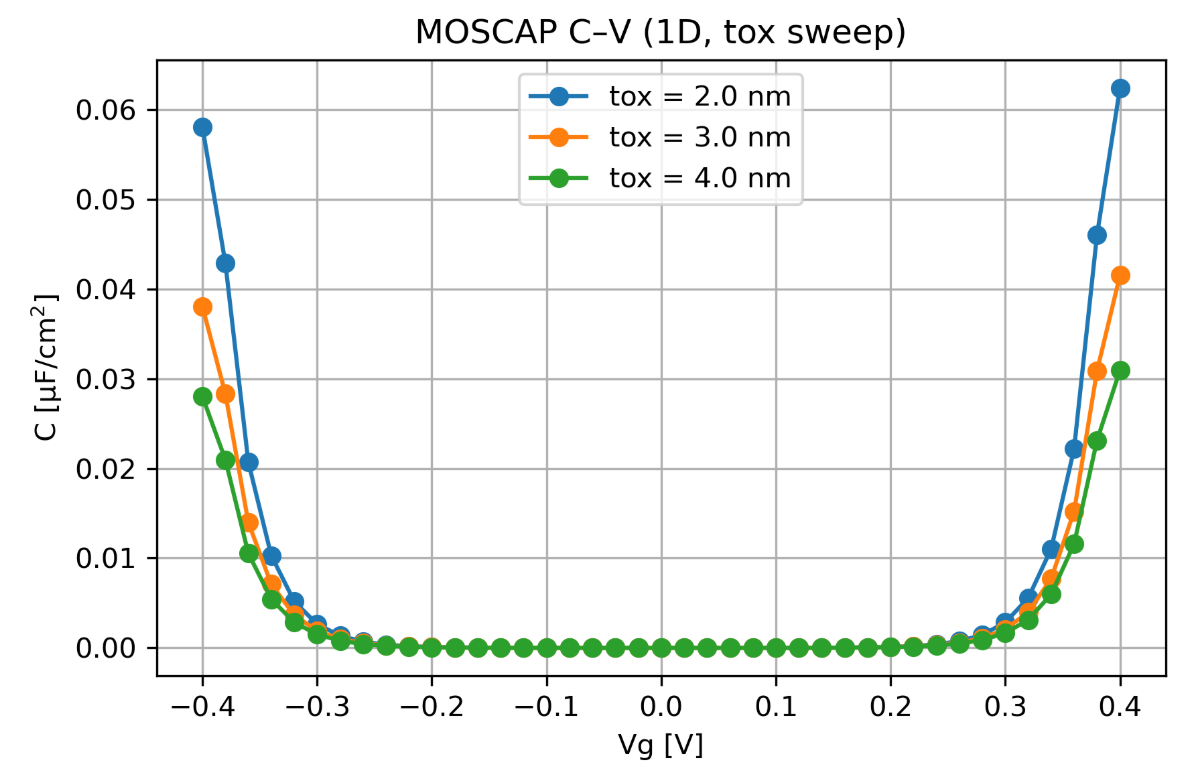
👉 Differences in potential distribution appear as capacitance.
📊 Example ②: nMOS $V_g$–$I_d$ Characteristics
$n$MOS $V_g$–$I_d$ characteristics with varying oxide thickness.
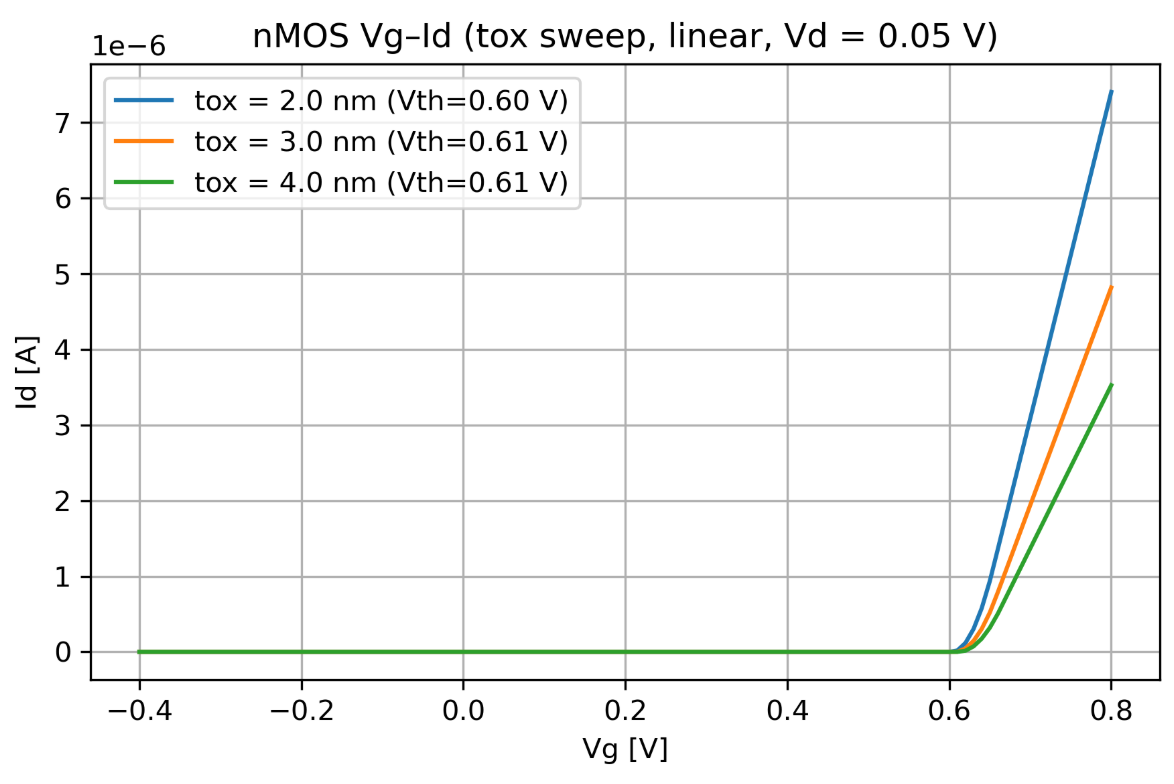
- Thinner $t_{ox}$ → lower $V_{th}$
- Higher $I_d$ at the same $V_g$
👉 Poisson → Drift–Diffusion → $I_d$
📊 Example ③: nMOS $V_d$–$I_d$ Characteristics
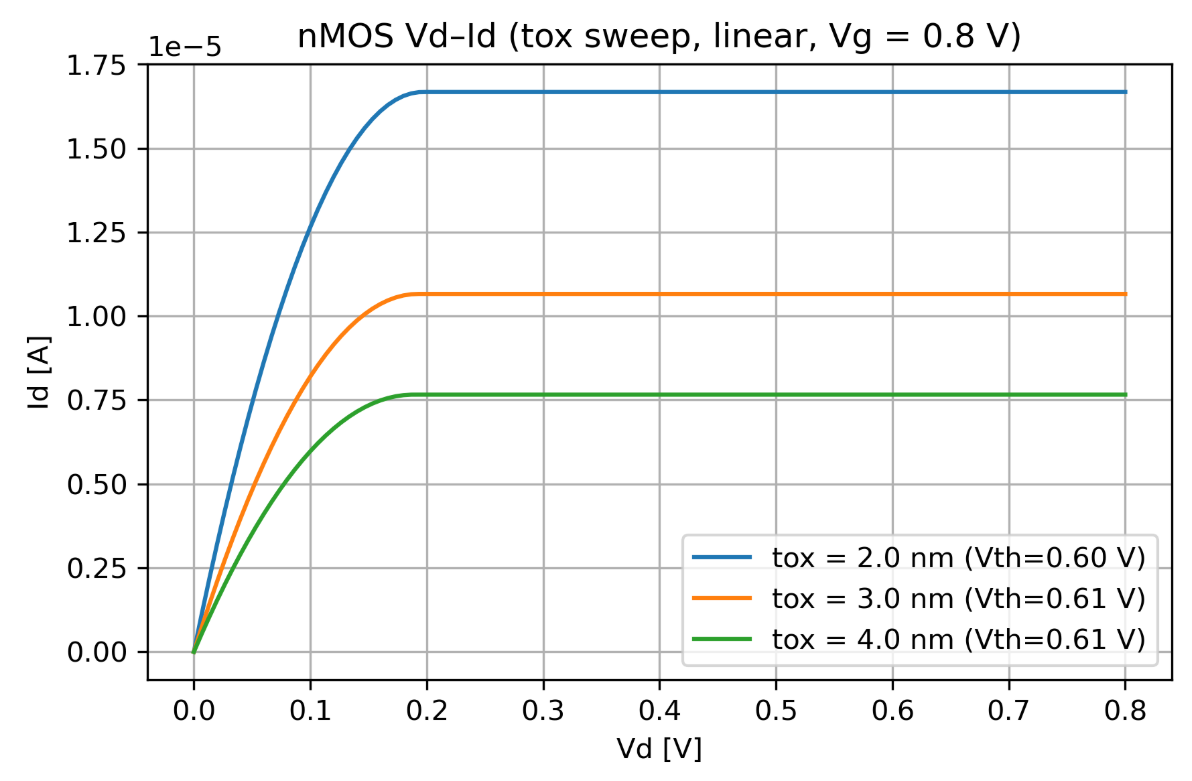
- Low $V_d$: linear region
- High $V_d$: saturation region
👉 Transport equations naturally create operating regions.
🔗 TCAD Is Not the Final Goal
TCAD is extremely powerful, but it has limitations:
- High computational cost
- Too heavy for circuit-level design
This is where BSIM4 comes in.
Compressing the physics observed in TCAD
into a form immediately usable in circuits
That is the role of compact models.
📝 Summary
- MOSFET $V$–$I$ characteristics result from Poisson and Drift–Diffusion equations
- Electrostatics create the channel; transport equations determine current
- TCAD reveals the moment when equations become reality
▶ Next Article
👉 03: What Is BSIM4? — A Compact Model That Translates Physics into Circuits
🧩 The SemiDevKit series continues from
“TCAD → BSIM → SPICE → Reliability.”