29.【Visualization】Understanding P-Control Gain Tuning Through Animation
tags: [“Control Theory”, “PID Control”, “P Control”, “Visualization”, “Python”]
The “I Think I Get It” Problem with P-Gain Tuning ⚠️
In textbooks, P control is usually explained like this:
- Increasing Kp makes the response faster
- Increasing it too much causes oscillation and instability
While this is logically correct,
it is honestly hard to grasp intuitively how the response evolves over time.
🎞 Comparing Responses Simultaneously with Animation
To address this, the step response of P control was visualized
by changing only Kp and animating the results side by side.
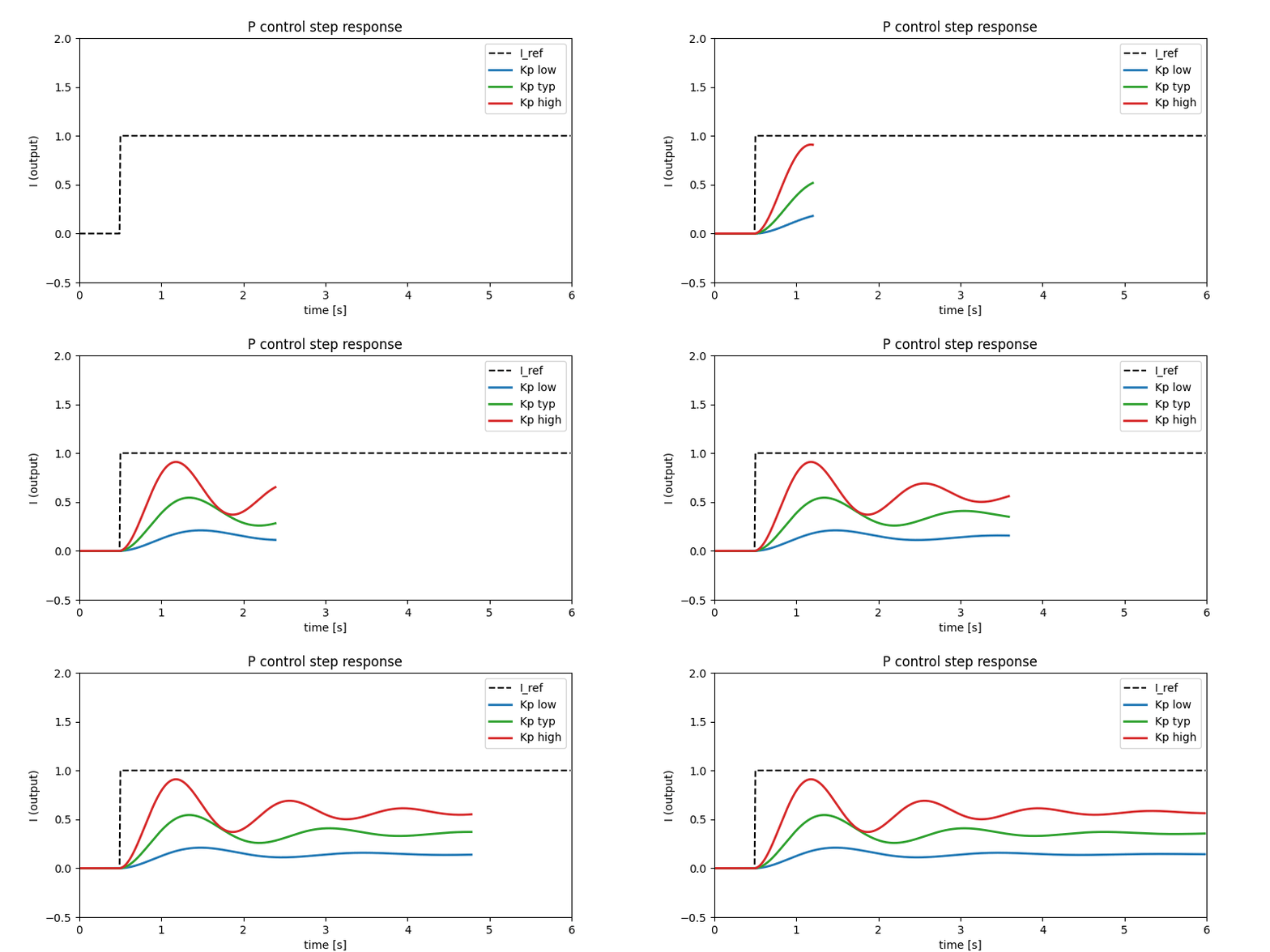
What to Pay Attention To
- Same plant
- Same target value (step input)
- Only Kp is changed
👉 Because the three responses
👉 progress along the same time axis simultaneously,
you can immediately see differences in:
- Rise time
- Overshoot
- Oscillation behavior
🧩 GIF Generation Code (Excerpt)
In this GIF,
the simulation is run by keeping all conditions the same and switching only the gain.
responses = [simulate_p(Kp) for Kp in Kp_list]
This single line does the following 👇
- Same plant model
- Same target value
- Only Kp is varied
- Each response is drawn simultaneously as it evolves over time
📌 Things that are hard to convey with static plots—
📌 such as “where it starts to become dangerous”—
become clearly visible through motion.
📎 Python Code Used
The full code used to generate the GIF is available here 👇
- P-control step response animation
https://github.com/Samizo-AITL/qiita-articles/blob/main/demos/gif_anim/p_step_only.py
Running it will generate
the exact same GIF used in this article.
✨ Summary
- Increasing Kp makes the response faster
- But it also increases oscillation
- Increasing it further pushes the system toward instability
This continuous progression of change
is immediately clear when viewed as an animation.
🧠 Closing Thoughts
Both semiconductor physics and control theory
are fundamentally dynamic phenomena that depend on time and conditions.
Animation serves as
a powerful set of training wheels 🚲
to support intuitive understanding of these systems.