22.【Generative AI Experiment】Verifying with Temple Architecture
Comparing 10 Prompt Directive Variations in Image Generation
tags:
- GenerativeAI
- ImageGeneration
- Prompt
- Experiment
- Architecture
- Temple
🎯 Introduction
In the previous article, we used “Kyoto landscapes” as the theme and examined
how differences in prompt directive words affect image-generation results.
This article is a continuation of that experiment.
Here, we fix the theme to “Temple Architecture” and apply the same comparative method.
Unlike landscapes, architecture has clearly defined:
- Form
- Structure
- Style
- Constraints
As a result, prompt directives act much more like explicit design inputs.
🎯 This experiment focuses not on mood, but on how structural directives take effect.
🧠 Why Choose “Temple Architecture”?
Temple architecture is an excellent subject for image-generation experiments.
- 🏯 Highly standardized structures (roofs, columns, axes)
- ⏳ Clear distinctions between eras and styles
- 🧱 Difficult to completely collapse even when abstracted
In short:
The difference between vague and precise instructions becomes visually obvious
If the previous “landscape” experiment leaned toward atmosphere,
this one is firmly structure- and design-oriented.
🔬 Experimental Conditions (Fixed Rules)
The following conditions are fixed throughout the experiment:
- Theme keyword: Japanese temple architecture
- Variables per run: only one changed element
- Models: DALL·E / Stable Diffusion / Midjourney, etc. (not specified)
- Observation targets:
- Structural clarity
- Stylistic consistency
- Degree of abstraction
- Staging (light and composition)
🔬 Variables are minimized so that the effective change can be clearly identified.
⚙️ Base Prompt (Common)
The following prompt is used as the common base,
and only the differences are modified in each experiment.
Japanese temple architecture,
wooden structure,
clean composition,
natural lighting,
no text, no logo, no watermark
⚙️ Priority is given to observing differences, not overall image quality.
🔬 “Temple Architecture” Fixed — 10-Pattern Experiment Table
| No. | Change Type | Prompt Difference | Main Visual Change | Observation Focus |
|---|---|---|---|---|
| 1 | Noun | photograph of Japanese temple architecture |
Photo-like realism | Attraction to real temples |
| 2 | Noun | illustration of Japanese temple architecture |
Iconic rendering | Organized composition and color |
| 3 | Abstraction | abstract visualization of temple architecture |
Simplified forms | Limits of structural retention |
| 4 | Specificity | realistic wooden temple structure |
Structural emphasis | Clear columns and beams |
| 5 | Emotion | calm and quiet temple architecture |
Static feeling | Reduced saturation and staging |
| 6 | Emotion | dramatic temple architecture |
Theatrical | Emphasized light and shadow |
| 7 | Era | Edo period Japanese temple architecture |
Style fixation | Era overrides realism |
| 8 | Contemporary | modern reinterpretation of temple architecture |
Reinterpretation | Changes in materials and form |
| 9 | Viewpoint | aerial view of temple complex |
Bird’s-eye layout | Placement and axiality |
| 10 | Viewpoint | interior view of temple hall |
Interior space | Column layout and depth |
🔬 Generated Image Comparison (10 Patterns)
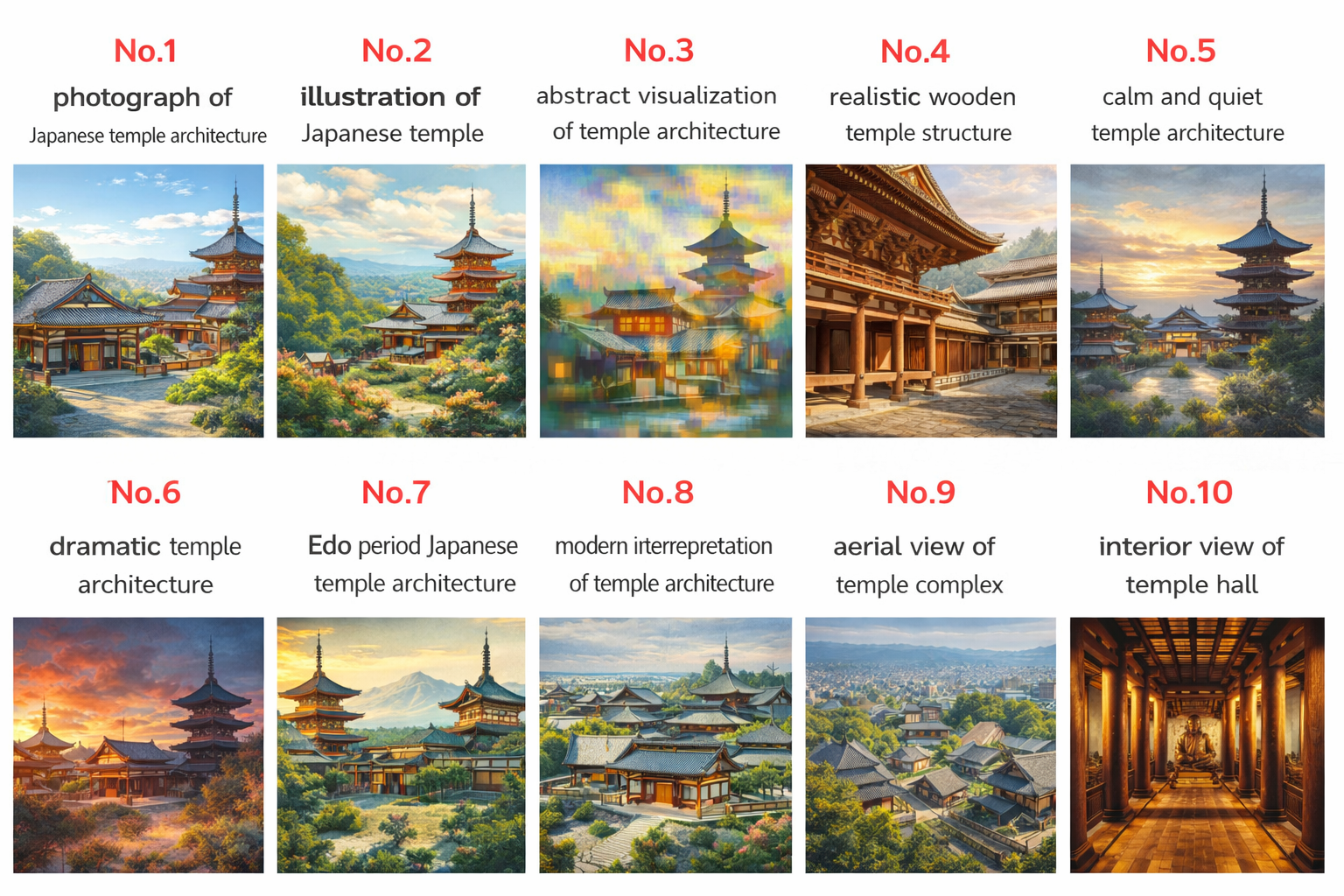
Figure 1: Ten generated results with temple architecture fixed,
changing only directive words in the prompt.
🧠 Observations and Findings
① In Architecture, “Structural Words” Have Top Priority
Words such as:
architecturestructurewooden
constrain output far more strongly than in landscape themes.
👉 In architectural prompts,
noun precision directly equals structural precision.
② Even When Abstracted, Structure Does Not Fully Collapse
Even with abstract visualization specified, elements such as:
- Layered roofs
- Vertical–horizontal relationships
- Symmetry
are preserved to a certain degree.
🧠 Temple architecture is a structurally robust subject.
③ Emotion Words Act on the “Decorative Layer”
- calm
→ lower saturation, uniform lighting - dramatic
→ backlighting, strong contrast
Rather than altering the building itself,
these words mainly affect light, sky, and surrounding elements.
⚠️ ④ Era Specification Completely Overrides Style
Terms like Edo period instantly fix:
- Architectural forms
- Ornamentation
- Color palettes
⚠️ Extremely powerful, but prone to overriding other instructions.
⑤ Viewpoint Changes “How the Structure Is Understood”
- aerial view
→ understanding layout and temple complex composition - interior view
→ understanding column grids and spatial scale
👉 Choose the viewpoint based on what you want the viewer to understand.
⚙️ Practical Implications
- 🧱 Architectural visuals
→ Place material and structural terms first - ⏳ When unifying style
→ Prioritize era specification - 📘 For explanatory purposes
→ Viewpoint specification is critical
✅ Summary
- In architectural themes, prompts function almost as design constraints
- Even with abstraction, structure does not break easily
- Compared to landscapes, logical difference observation is much clearer
By progressing from landscape → architecture,
one gains a deeper understanding of how image-generation prompts operate.
End.