40. Results and Observations
📊 Final GDS Generation with SRAM Hard Macro
🎯 Purpose
This document summarizes the final results of the project, marking the successful completion of M3.
It focuses on:
- 🧩 End-to-end RTL → GDS completion using OpenLane2
- 🧱 Integration of an SRAM hard macro as a fixed physical constraint
- 🧠 Practical observations from macro-aware physical design
- ⚠️ Known limitations and lessons learned
✅ Final Outcome (Summary)
Achieved Results
- OpenLane2 Classic flow completed successfully across all stages
- A final GDS was generated that includes:
- Standard-cell logic
- An externally provided SRAM hard macro
- The entire flow is fully reproducible using documented commands and configuration files
This confirms that:
OpenLane2 can reliably handle hard macro integration
in a realistic SoC-style physical design flow.
📦 Generated Artifacts
OpenLane2 produces per-run artifacts under the design directory:
designs/<design_name>/runs/RUN_<timestamp>/
└─ final/
   ├─ gds/
   │  └─ <design_name>.gds
   ├─ lef/
   ├─ def/
   ├─ views/
   └─ reports/
Primary Deliverable
final/gds/<design_name>.gds
Final top-level layout including the SRAM macro
This GDS has been verified by visual inspection.
🔍 Layout Verification
Visual Inspection
Using KLayout, the following were confirmed:
- The SRAM macro appears as a large, fixed rectangular block
- Standard cells are placed legally around the macro
- Halo / keepout regions are respected
- No overlaps between macro and standard-cell placement
This confirms correct macro placement and floorplan enforcement.
🧪 DRC and LVS Status
DRC
- Top-level DRC completed within the project scope
- Warnings may appear around:
- Macro boundaries
- Power distribution structures
- Internal SRAM DRC is intentionally excluded
All reported issues are understood and acceptable for this project.
LVS
- LVS is limited to top-level connectivity
- The SRAM macro is treated as a blackbox
- Full sign-off LVS is explicitly out of scope
This matches the stated project policy.
📈 Metrics and Observations
Observed qualitative trends:
- Area utilization increases significantly due to the macro footprint
- Routing congestion concentrates near macro edges
- Floorplan quality has a larger impact than synthesis optimization
Exact numerical metrics are design- and macro-dependent and are not the primary focus of this work.
🧠 Key Lessons Learned
1️⃣ Macro Placement Dominates the Design
- Macro placement decisions must be made early
- Small placement shifts can drastically affect routability
2️⃣ PDN Is the First Real Bottleneck
- SRAM power pins must align with the top-level PDN
- PDN-related issues are the most common cause of failed runs
3️⃣ Abstract Views Are Essential
- LEF / maglef views dramatically reduce DRC noise
- Attempting full SRAM internal DRC/LVS is impractical
4️⃣ OpenLane2 Is Macro-Capable but Explicit
- Macro integration is not automatic
- Constraints must be expressed explicitly
- The flow is more transparent and debuggable than OpenLane (v1)
⚠️ Known Limitations
The following limitations are intentional:
- Single SRAM macro only
- No advanced timing optimization
- CTS behavior around macros not tuned
- No production-grade sign-off
This repository prioritizes:
Clarity · Realism · Reproducibility
over maximum optimization.
🔬 Recommended Next Experiments
Possible extensions include:
- Multiple SRAM macros
- Different macro orientations and placements
- Manual PDN refinement
- Comparison with OpenLane (v1) macro handling
- Integration of OpenRAM-generated SRAM macros
These can be explored without changing the repository structure.
🧭 Final Remarks
This project demonstrates a practical, macro-aware OpenLane2 workflow.
Its value lies in:
- Clear separation between logic and hard macros
- Explicit physical constraints
- Fully reproducible, documented steps
It provides a solid foundation for further exploration of:
Macro-based physical design using OpenLane2
🖼 Layout Evidence
Figure 1: SRAM Macro Block-Level View
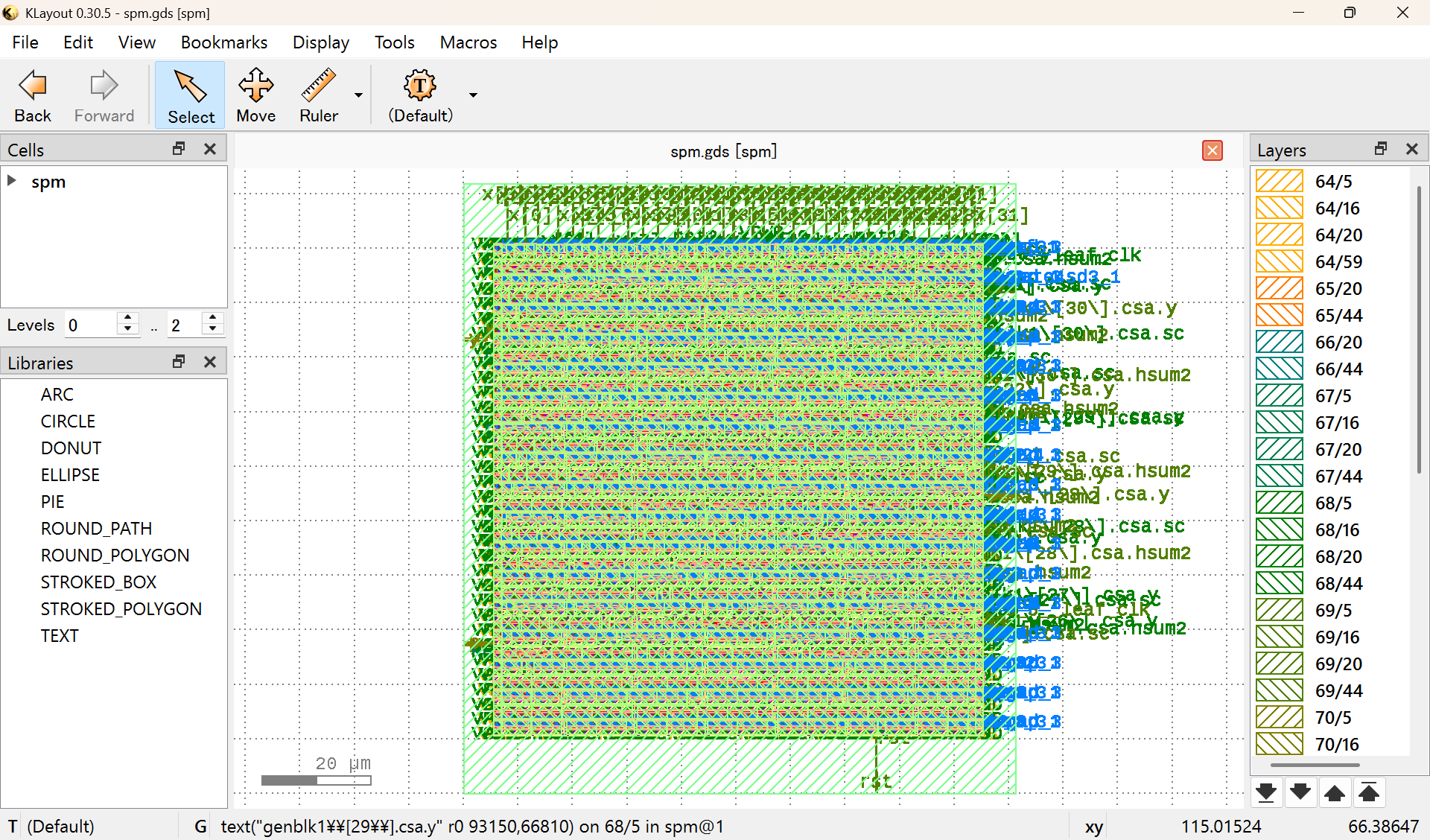
The SRAM hard macro is integrated as a fixed block in the final GDS.
Figure 2: Standard-Cell-Level View
(SRAM Internal Layout Not Visible)
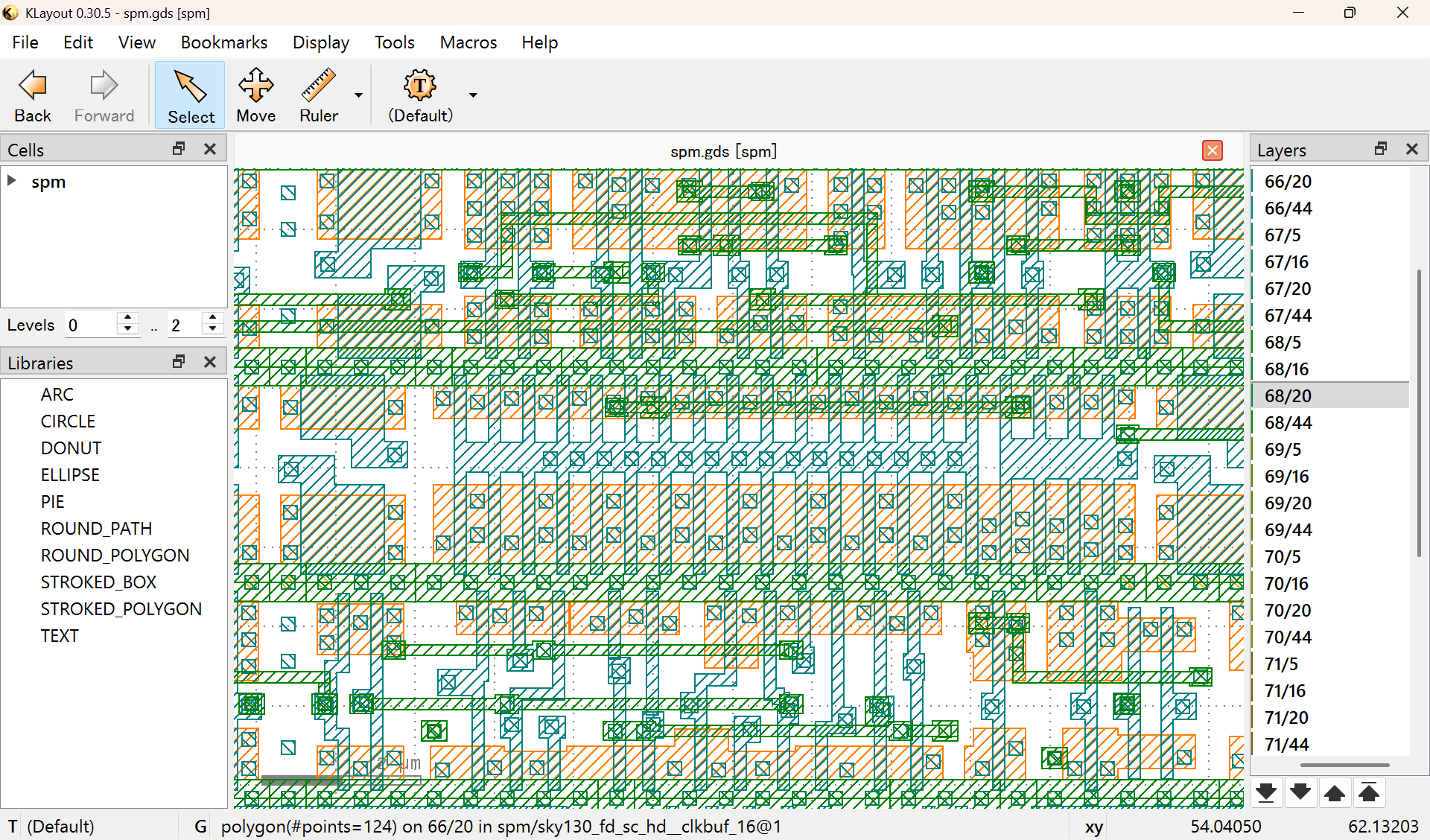
Only standard-cell geometry is visible.
The SRAM macro is treated as a hard macro and its internal transistor-level
layout is intentionally abstracted.
Last updated: Final GDS generation verified and documented ✅