Evaluation Results — AITL Controller B-Type
Reliability-Oriented Adaptive Control Assessment
1. Purpose of This Evaluation
This document summarizes the evaluation results of AITL Controller B-Type,
with a focus on reliability preservation under plant aging, rather than short-term performance maximization.
The objective is not to claim that B-Type outperforms A-Type or PID universally,
but to verify the following architectural claim:
B-Type guarantees a lower bound of reliability while allowing limited, supervised adaptation.
2. Evaluation Scope and Conditions
2.1 Control Target
All tests use the same analytical plant model:
\[G(s) = \frac{K}{Ts + 1} e^{-Ls}\]Aging effects are modeled as:
- Increase in effective dead time ( L )
- Decrease in effective gain ( K )
2.2 Incremental Controller Comparison
Controllers are evaluated incrementally, reflecting architectural causality:
| ID | Controller Configuration |
|---|---|
| C0 | Initial (no aging, reference) |
| C1 | Fixed PID (aged plant) |
| C2 | PID + FSM (A-Type) |
| C3 | PID + FSM + Reliability Guard (B-Type) |
| C4 | PID + FSM + Reliability Guard + LLM (conceptual) |
3. Overall Comparison (All Configurations)
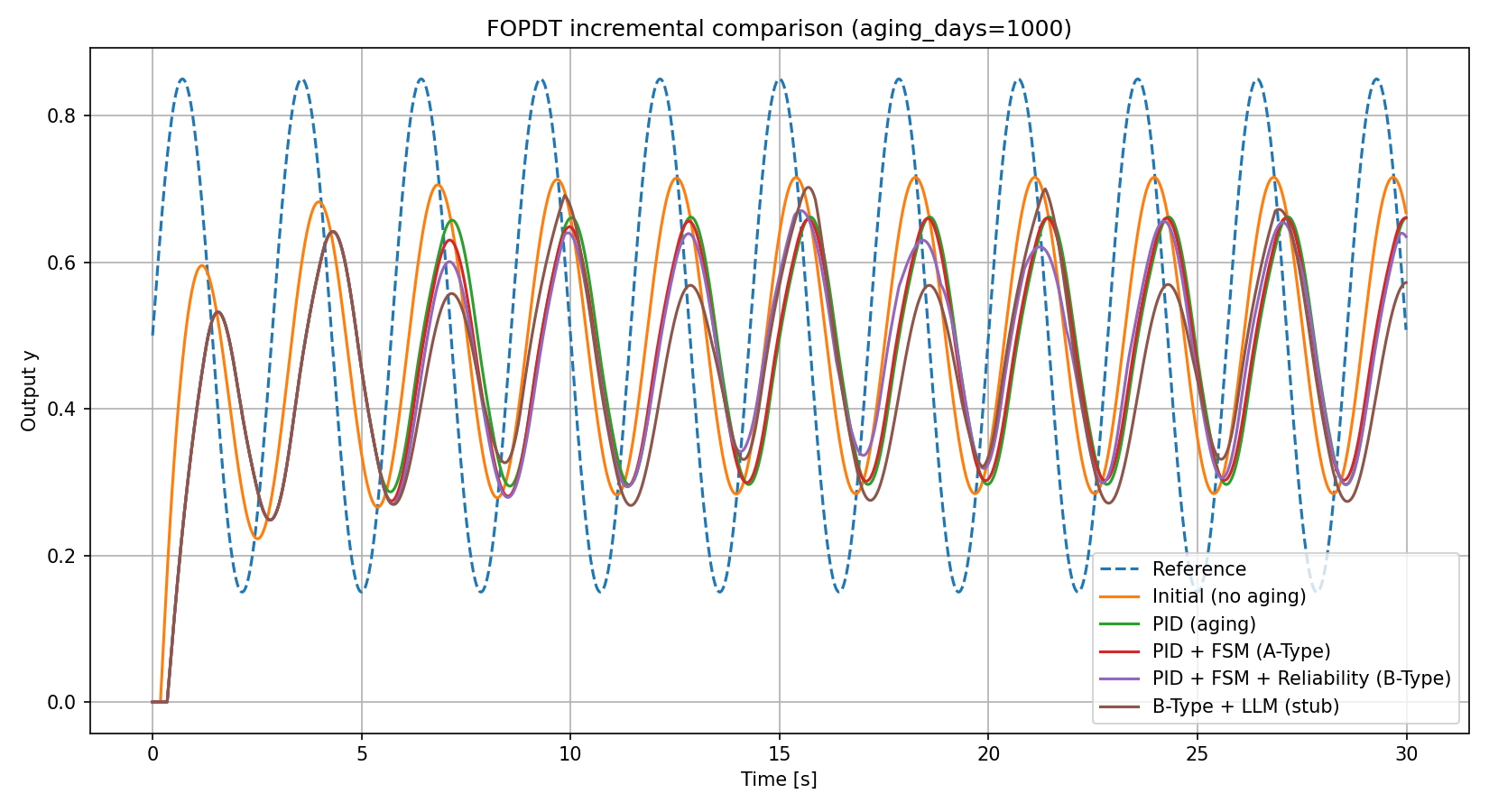
This figure shows the incremental evolution of control behavior as architectural layers are added.
Key observation:
- Performance improves initially with adaptation
- Reliability-oriented constraints intentionally limit over-compensation in B-Type
4. Fixed PID vs Initial (Aging Effect)
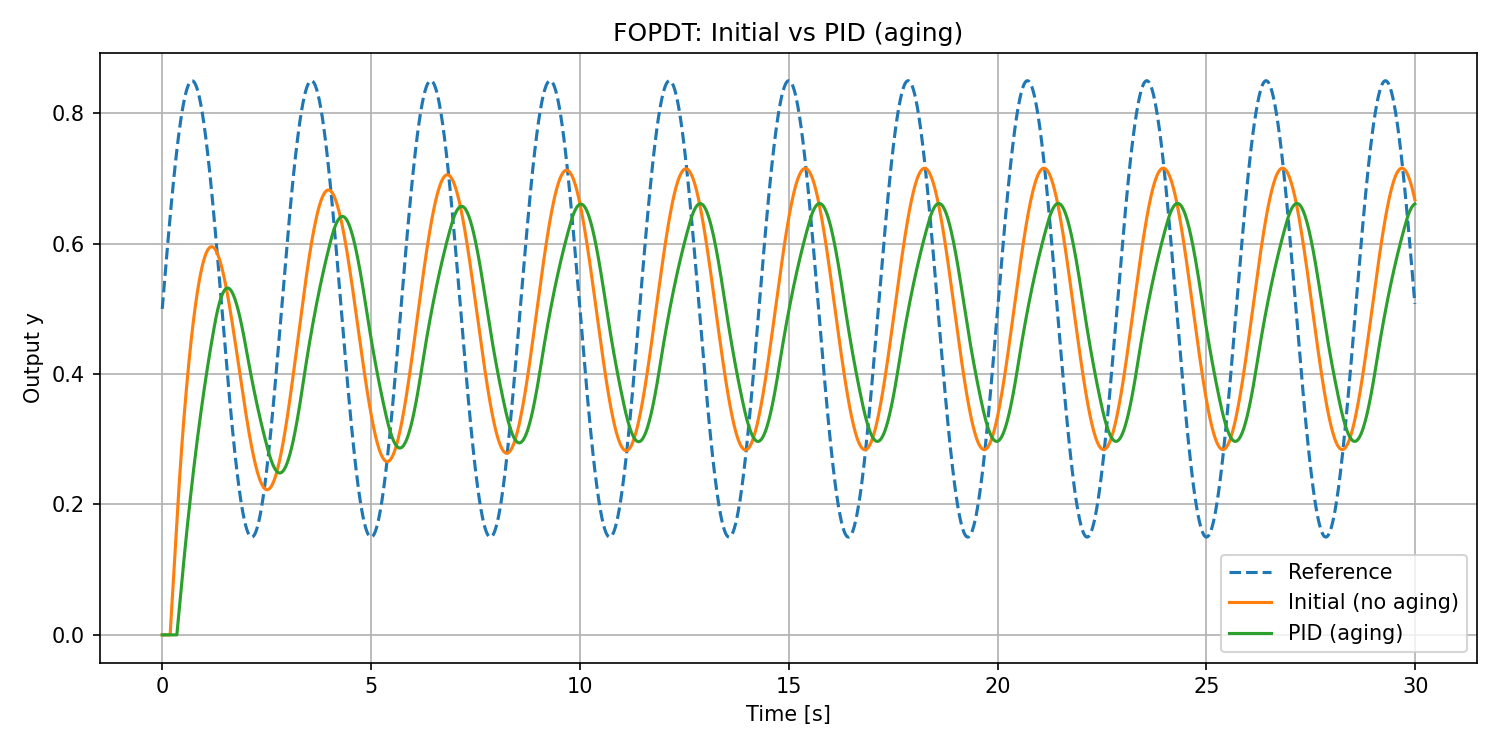
Observations
- Clear phase delay increase
- Amplitude attenuation
- Stability preserved
Interpretation
This establishes the baseline degradation caused by aging, without adaptive intervention.
5. PID vs PID + FSM (A-Type)

Observations
- Phase delay is partially recovered
- Output amplitude increases
- FSM actively switches PID gain sets
⚠️ However:
- Tendency toward over-compensation
- Increased FSM switching frequency
- Long-term reliability indicators worsen
Conclusion
A-Type demonstrates adaptability, but lacks explicit reliability guarantees.
6. A-Type vs B-Type (Reliability Guard Effect)
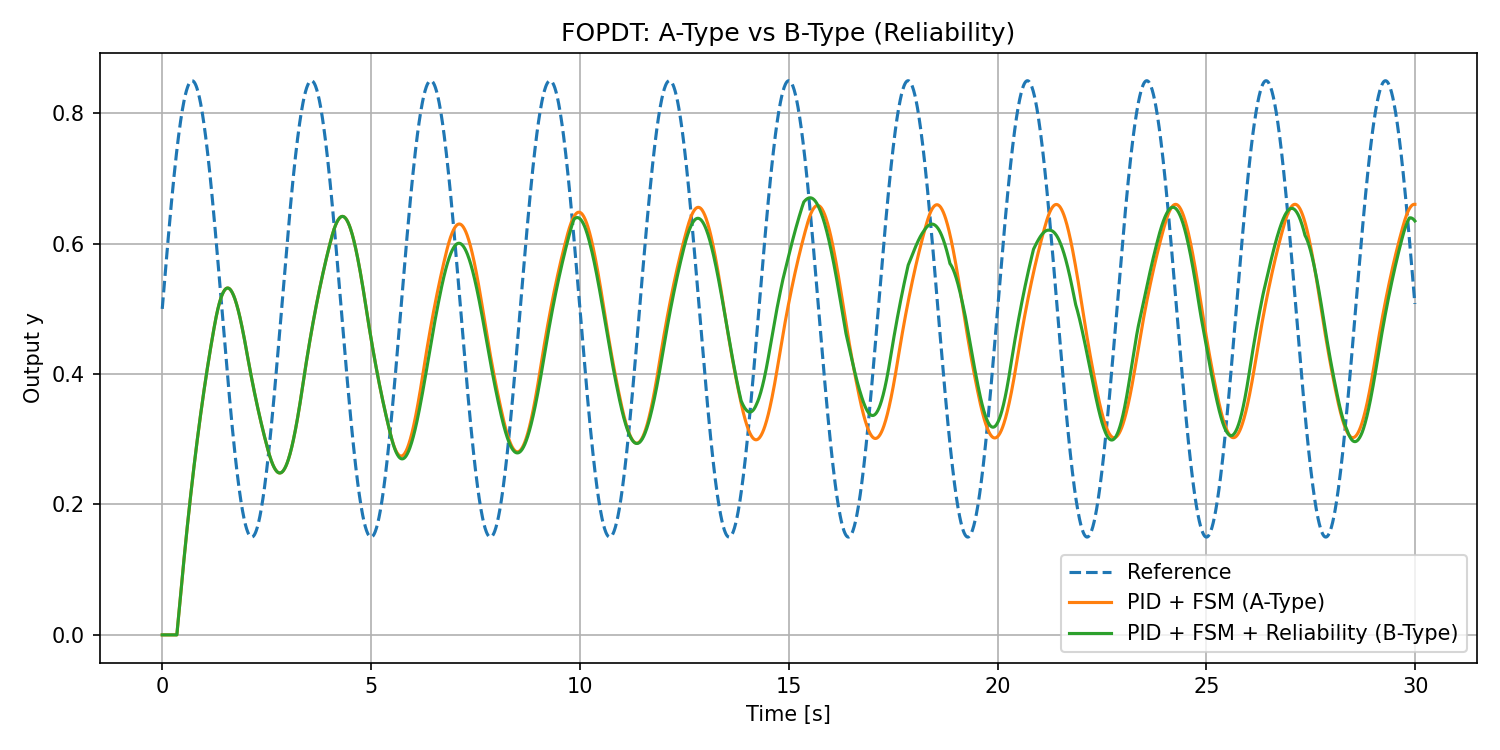
B-Type behavior
- FSM adaptation is constrained by reliability thresholds
- Gain amplification is limited
- Switching activity is bounded
Result
- Phase recovery is intentionally incomplete
- Amplitude recovery is partial but stable
✅ Reliability lower bound enforced
❌ Full performance recovery intentionally sacrificed
This is by design, not a limitation.
7. B-Type vs B-Type + LLM (Conceptual Layer)
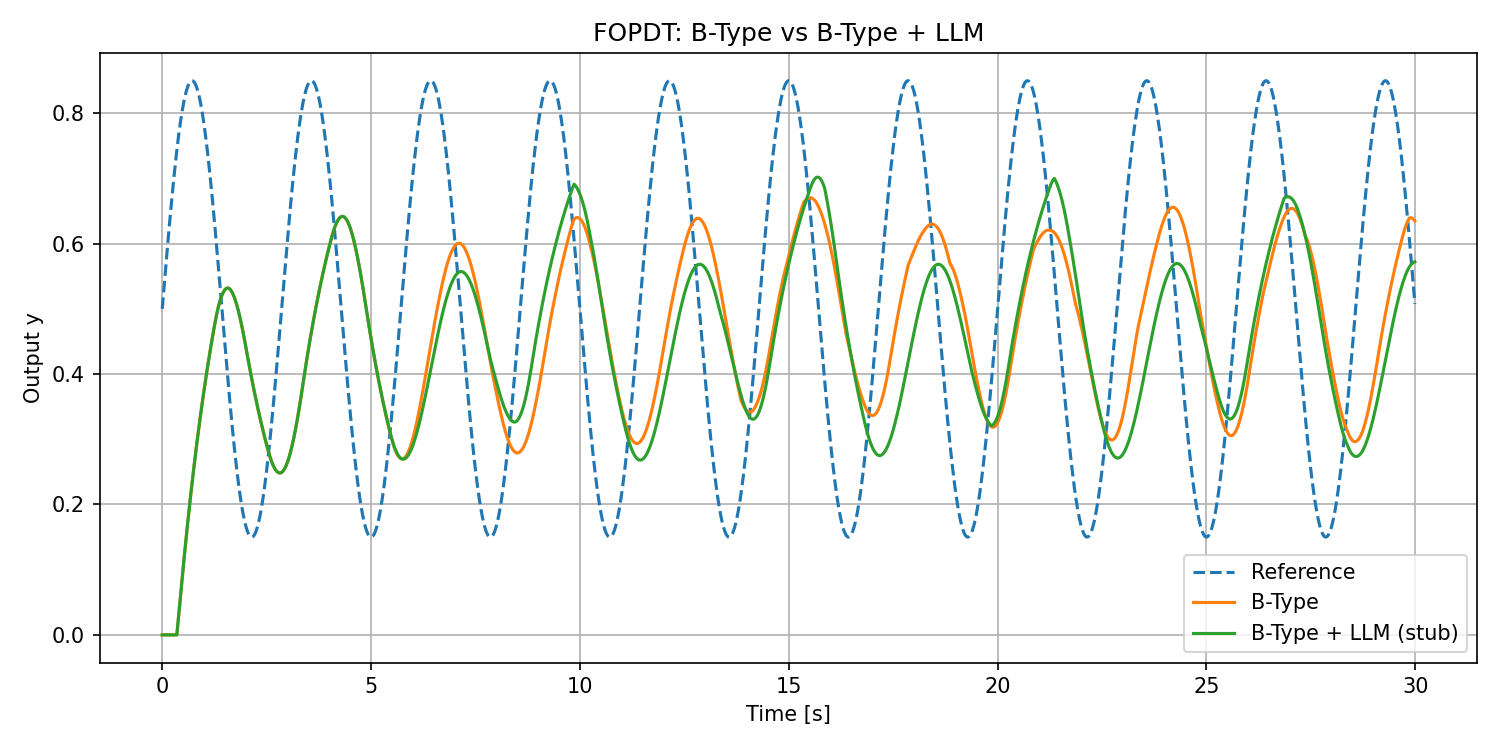
Role of LLM
- Not used for real-time control
- Operates as an offline / supervisory design aid
- Adjusts FSM thresholds and PID sets within safety envelopes
Key constraint
LLM does not override Reliability Guard decisions.
Observed effect:
- Slight phase alignment improvement
- No reliability constraint violations
8. Interpretation of Results
8.1 Why B-Type Looks “Worse” Than A-Type
Because B-Type refuses to over-adapt.
What appears as reduced tracking is actually:
- Actuator stress prevention
- Suppression of hidden reliability debt
- Enforcement of long-term operability
8.2 Explicit Design Trade-off
| Aspect | A-Type | B-Type |
|---|---|---|
| Short-term performance | High | Moderate |
| Adaptation freedom | High | Restricted |
| Reliability predictability | Low | High |
| Deployment readiness | Experimental | Practical |
9. Final Conclusion
This evaluation confirms that AITL Controller B-Type:
- Enforces explicit reliability constraints
- Allows only supervised, bounded adaptation
- Handles aging-induced degradation safely
In summary:
A-Type proves that adaptation is possible.
B-Type proves that adaptation must be constrained.
B-Type fulfills its intended role as a
deployment-oriented, reliability-first adaptive control architecture.
End of Evaluation Results